Friday, September 23, 2016

Robots and Steel

We had two exciting experiences recently in the high school Academy. Firstly, in the 9th/10th Grade Foundations of Engineering group, we decided to take a break from the rigours of trigonometry to see some robotics in action. Scott Gary, a Providence parent, brought in his Battle Bot--The Piecemaker!

The Piecemaker has competed in several events about fifteen years ago, including "Robot Wars" over in London. The robot enjoyed mixed success, going against such fearsome competitors as Bunny Attack, Hannibal, and Techno Trousers.

Scott pulls off the cover to show the internal workings of The Piecemaker;
Jakob and Samy have eyes on the flamethrower!

Alec and Colby watch as Scott describes the
internal wiring, which was actually less complex
than the robots we will be building next month

The Piecemaker is controlled by a regular remote-controlled aircraft setup, which sends signals to the powerful wheelchair motors at the wheels, and also to the metal cutting disc on the front. Scott showed us a worn-out disc from previous competitions; the fuzzy debris from other robots was still stuck on the blade!

Scott takes The Piecemaker outside to fully demonstrate its destructive capacities!

The students were allowed to operate the robot... be assured that the rotary cutting
disc was disconnected first!

Scott attempted to light the flamethrower, but the wind just wouldn't cooperate...
too bad!
Low-res proof of former glory: The Piecemaker (middle right) goes head-to-head
with Bunny Attack (left)

This week, the members of the 11th/12th Grade group, Advanced Engineering, took a walking field trip to the nearby Santa Barbara Forge & Iron over on Gutierrez Street. The business is owned and operated by Dan and Andy Patterson, who are newly related by marriage to our own Mr Hurt. Sadly, two of our group of six were out sick, and they were missed!

Dan met us, and began by showing a few of the projects that he currently has on the boil, and how he uses Trimble SketchUp to plan his designs after taking the initial site measurements. Tys and Sarah Jane spent much time last year learning SketchUp, and Kylie and Caleb recently had their first exposure to the CAD program. It was gratifying to see the exact same software in action at a thriving Santa Barbara business just blocks away from the school.

Dan opened the tour by showing some SketchUp projects

Dan was also able to show us around the shop, which is filled wall to wall with fascinating industrial machinery. Workers busily hammered away at iron and steel, drawing it out into custom-made features destined for various local businesses and residences.

Tys, Sarah Jane, Kylie, and Caleb look on as Dan demonstrates the various
co-ordinate axes of the drill press/lathe

This particular piece is destined for a local museum, at which we hope our students
will soon have opportunities to volunteer... more on this later!

Sometimes you just gotta hammer away on
a good old-fashioned anvil

And sometimes you use a jet of energized plasma on a computer-controlled machine;
the students gratefully finished their tour with this huge piece of equipment

Many thanks to Dan and Andy and everyone at Santa Barbara Forge & Iron for their warm reception of our students. Their creative passion, combined with hands-on skills and applied mathematics, are an inspiring example for us. Thanks again also to Scott for bringing in The Piecemaker.

Stay tuned for more projects and field trips and guest speakers! The year is just getting started.

Wednesday, September 14, 2016

Advanced Engineering: Community Design Project

We're in the fourth week of school now, so it's a great time to unveil our Big Idea for the 2016-2017 school year. The Advanced Engineering group, comprising Tys, Aaron, Sarah Jane, Kylie, Jake, and Caleb, have been given a momentous task to accomplish.

From left: Jake, Caleb, Aaron, Tys, Mr Meadth, Kylie, Sarah Jane,
and a Pacific Gray Whale

Drum roll, please...

They will be working on a year-long project to design and construct a play structure for the Providence Lower Campus!

Most of these students already learned to do CAD last year, creating models of orphanages, Mars habitats, and small houses. This was all done from a purely "design" perspective, focused on aesthetics and interest alone.

Sarah Jane and Jake showing their CAD model for an African orphanage last year

By contrast, the point of this year's work is to understand structural engineering: materials science (just when will that piece of timber break?), loads and stresses (how much tensile stress is that chain carrying?), column behaviour (when will a long thin supporting column buckle?), and so much more.

So, after making a design that is interesting and aesthetically pleasing and fits its environment, the students will bring their new skills to bear on their structure, which will enable them to select material types, choose thicknesses, add triangular structures, etc. This will be far more math-and-physics based than last year's work.

But for now it's all fun and games. We've been researching nearby playgrounds...


...appreciating local artwork...


...performing structural tests on candidate materials...


...speaking on location with the all-important client, Mr. Knoles...


...getting inspiration...


...critiquing ideas...


...and getting it all down on paper.


This week also marks the submission of a grant to a local nonprofit to help fund this project. The students wrote this grant themselves, and will be waiting hopefully for the response. Stay posted for more updates on this exciting work!

(photos by Rodney Meadth and Tys vanZeyl)

Wednesday, September 7, 2016

Engineering at Providence: The First Few Weeks

As we step into the 9th day of classes, I'd like to give an update on all things engineering at Providence. With eighteen high schoolers in the Academy, fourteen middle schoolers in the elective, and three different classes between them, there's a lot going on!

In the high school, we talked about how all technology is an amplifier; that is, it takes the output of the user or the designer and magnifies it--for good or for bad. Technology in and of itself cannot create, and it is not inherently good or evil. The responsibility is on the user or the designer to exercise wisdom and virtue, so that their technology is amplifying for good. Lofty thoughts!

One historical amplification of human effort and creativity occurred with the widespread implementation of the waterwheel in medieval Europe. The waterwheel could be connected via a crank and connecting rod (or a cam) to convert continuous circular motion into reciprocating linear motion. Did I lose you? Take a mental break and watch Sarah Jane and Aaron demonstrate...


Imagine using running water to power a system that can bounce something back and forth over and over and over again. You can crush gravel, pound pulp to make paper, stitch cloth, saw wood... the possibilities are practically endless!

The process can also be reversed, as shown by Tys and Caleb below. This system is what's happening inside your car's engine, with pistons moving up and down (linear) to make a central drive spin (circular). It's no exaggeration to say that modern industry depends on this simple setup.


David and Todd also came up with an impressive cam system, complete with a tiny weighted hammer on one end.

David and Todd show off their tiny industrial device

Samy and Jakob designed a sideways system that imitated the kind of action that would be used for sawing a piece of wood. The long white piece moves in and out horizontally as the wheel spins.

Samy and Jakob with their sawing machine

Did I mention that all of this was done by the students themselves, without any help from me beyond describing what the goal was?

Ben and Alena with another crank-connecting rod machine

Students have also been getting into some CAD work (computer-aided design). Kylie is brand new to the world of CAD, but after a couple of coaching sessions by Sarah Jane, she is turning out models with the best of them. She also learned the hard lesson that 3D printing is not a foolproof process...


But you can always try again.


And sometimes you just end up with a piece of modern art.

Over in the middle school elective, we began with our traditional opening challenge--record of 26 books still held by Josh and Pedro from a couple of years ago.

Constraints:
  • At least 4 inches / 10 cm high
  • Three sheets of paper
  • 1 metre of tape
  • Freestanding (not attached to the table)
  • As many books as possible!

Cameron and James look on as the pile grows

One central cylinder--strong but not stable


Mr Meadth also showed the principle of inertia--that objects want to keep doing exactly what they are currently doing. A cardboard tablecloth is not the very best thing for this, but the students seemed to get the idea, with some help from Christine.


Note the heavier cast iron teacup staying perfectly in place. The salt and pepper almost did, but as Dylan pointed out, the higher centre of gravity made it more difficult despite their inertia wanting to stay in place.

That's a taste for now of all that we are doing. Coming up this month: playgrounds, battle bots, earthquake-proofing, trigonometry, and more!


Monday, August 8, 2016

Educational Design Project: Part III

Summer update time! Take a break from all that relaxing and read on...

Today marks an important milestone: the Providence Engineering Academy's Educational Design Project finally had all student designs approved by their clients! Mrs McLemore in the 1st Grade was able to confirm that the latest iteration of Isabelle's pencil clip was in fact suitable for her class. We did feature Isabelle's Mark 7 in the last update on this project. Mrs McLemore tested Mark 9 today, which had a slight modification by Mr Meadth, and mass printing has already begun.

Isabelle's Mark 9, final and approved!

Before school ended, we had some other significant projects finish up as well. Jake took a break from building guitars to turn out a delightful middle school gear demonstration. This demonstration will show the middle school engineering elective in a very tactile way just how torque and rotational speed are traded off against each other; you can have one or the other but you can't max out both at the same time. It should also be noted that Jake's design was completely A-OK from when he first submitted it back in late March... it just took until May to coax such a complex shape out of our large Leapfrog printer. The science lab was littered with the debris of many failed attempts, as Mr Hurt will testify.

Jake serving up a pair of mounted meshing
gears, in a 1:3 ratio

Colby's ionic lattice underwent some key design changes--which is all part of the lessons learned. Chief among them was swapping out spherical atoms for slightly boxier ones (it's hard to print a perfect sphere on a flat platform). His connecting "bonds" also became completely separate in and of themselves, which also enabled us to control colors separately. In the end, Colby's design is an eye-catching work of art, fitting no fewer than 81 individual pieces into a large crystalline cube. Mr Meadth's addition of a simple base puts the whole thing front and centre in the Chemistry classroom, tottering on the precipitous edge of Mr Hurt's bookcase.

Mr Hurt receives Colby's design with a restrained show of indifference

Mounted on its end, representing a metallic lattice to all who will take notice

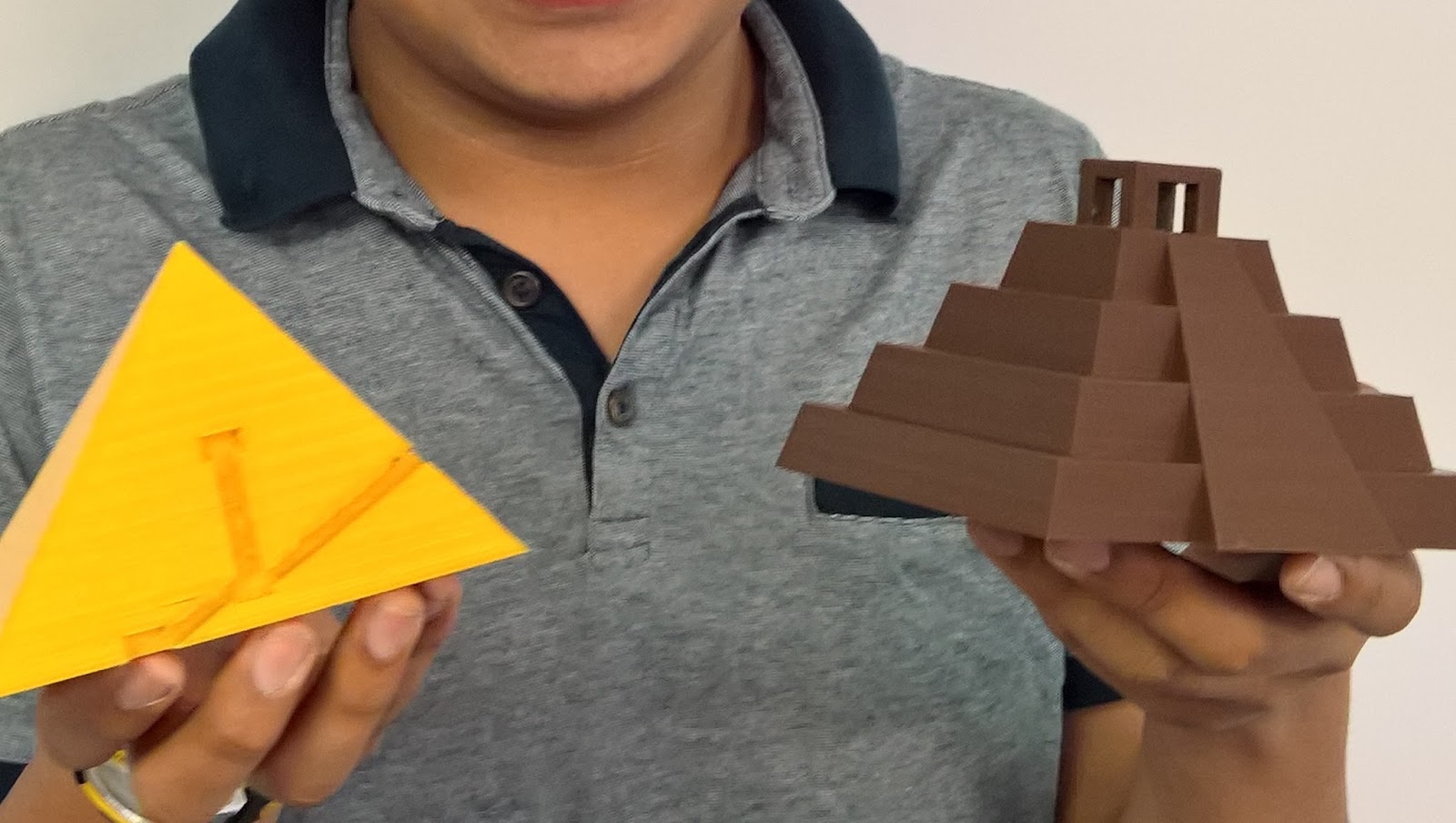
Josh's design took home the prize of "largest single printed piece of plastic", putting an Egyptian pyramid in juxtaposition with a Mesopotamian ziggurat. This hands-on manipulative is now happily abiding in Mrs Kleen's 6th Grade social studies collection. Note how the pyramid is in two parts, to show a representation of the tunnels and chambers within.

Pyramid (gold) vs ziggurat (brown), by Josh

The pyramid pulls apart to show a small network of tunnels and chambers

While Sarah Jane already finalized her design for the Engineering Academy USB drives back in March, it was not until just recently that the designs were printed in their final colors and had the drives inserted in place. These are worth seeing.

32 GB of goodness!

Engineering Academy students can use these to help carry around their
oh-so-important computer files--in style

And finally, some news from the Future Engineers "Star Trek Replicator" competition. Three of our students entered into this competition as an alternative to the Educational Design Project. The task was to create a 3D-printable object that was food-related (but not edible... apparently that point had to be clarified).

We are very happy to say that out of scores of entrants across the nation, Tys was selected to be a top-ten semifinalist in his age division! Tys' MCAPP was designed to allow planting and composting in a single hexagonal pot, which can then be easily tessellated for maximum efficiency in storage. The judges liked his work, and so do we! The low-resolution image is here below, but you can see the original here, and even download Tys' model for your own 3D printer (you have one, right?).

What does MCAPP stand for, you say?  Martian Compost
and Planter Pot

Thus concludes the various projects submitted by our Engineering Academy students. We'll finish with one more photo from the Providence 3rd Grade, taken upon receiving their class set of ten-sided dice.


More exciting things to come in the new school year!

Friday, June 10, 2016

Midde School Final Challenge Complete!

After weeks of hard work designing, building, and programming a Mars rover, four middle school teams headed out to the gym to put it all to the test. These robots were created entirely from scratch--no instructions, no plans, just the student teams and their own wits! The goal was to create a remote-controlled robot that could collect four 3D printed "Mars rocks" as quickly as possible, using whatever means necessary.

Team 1 (Sam, Cole, Nik, and Pedro) went for an asymmetrical design, driven by two strong rubber wheels in the back. An arm with a claw lowered down on one side to scoop up the rocks, bringing them up and over to drop into a large hopper, with more than enough capacity for all four rocks.

Team 1 presents their design to the class

Team 3 (Conner, Brennan, Isaac, and Tessa) decided to maximize speed and agility above all else. They gave their robot a very simple platform on the front, with a swinging arm to contain a single rock at a time. This meant that they would have to exit and re-enter the circle each time to extract their rocks.

Team 3 shows their simple but fast design

Team 4 (David, Samy, and Belen) went for a longer model with more than enough internal capacity for four rocks. Completely unique to the competition, they designed a "paddle wheel" on the front to sweep the rocks right into the belly of the robot. This all made for more difficult turning, but an efficient collection method.

Team 4 shows the longest design in the competition

Lastly, Team 26 (Todd, Ashlynne, and Deacon) designed a big, bulky robot with both caterpillar tracks and rubber wheels. Team 26 was the only team to employ two computers onboard, to account for their large number of motors. A robot arm reached over the front of the robot to close onto the rocks, before lifting them up into the hopper behind.

Team 26 shows the class their hybrid machine

After a day of presenting and time trials, the students played it out in the gym, with parents and fellow students cheering on. Each team scored at least one victory against someone else, although by the end of the first day, it was clear that Team 3 had an obvious speed advantage. With each round of play, they perfected their technique to get faster and faster!

Mr. Meadth and the crowd look on as Team 26 positions for another run;
Team 4 paddles its way forward unhindered

Brennan and Conner from Team 3 close in on another rock; Todd and Deacon
from Team 26 try to co-ordinate their efforts

Samy from Team 4 takes a turn at the controls while David
and Belen look on

On the second day of competition, the students knew it was time for the eliminations. Team 26 and Team 4 had given the shakiest performances up to this point, although both had won a victory against each other. Fighting for the best of three saw a victory in 1:03 for Team 4, then a victory in 1:15 for Team 26. With scores tied, Team 4 pushed through in their fastest performance yet, with an astounding 0:54. Team 26 eliminated!

Samy, holding three, anxiously waits for the fourth rock to
be collected by David

Ashlynne, having positioned Team 26's robot, looks on as Deacon steers it
toward the goal

In the next elimination round, the bulkier Team 1 faced off against the more agile Team 3. In a quick series of best of three, Team 3 established dominance, putting their fastest time on the board of four rocks in 0:30. Team 1 put in a valiant effort, but could not keep up and was eliminated.

Team 1 scoops up their second rock in the elimination round

Conner from Team 3 positions the robot as Brennan gets ready to make a run for
the pink rock

The very long Team 4 and the very quick Team 3 went through to the final round, for another best of three. Tensions were high, and Team 4 started off strong. Team 3 went straight into their typical repertoire: run in, grab, get out, repeat. Like a well-oiled machine, Team 3 took home a victory in 0:50. In the second of three, Team 4 came close to victory, but Team 3 once again won with 1:12--notabley, not as fast as Team 4's best time. However, a third round showed that, without a doubt, Team 3 deserved the grand prize!

Team 4 (left) and Team 3 fly into action in the final round

Already holding two, Team 4 (left) narrowly misses their next red rock, while
Team 3 closes in on the teal one


The winning students were awarded with gift cards and one of the rocks they had fought so hard to collect. Smiles all round, and we'll see what the Final Challenge had to hold in store next year!

Mr. Meadth congratulates Tessa, Conner, Brennan, and Isaac for a job well done

All the students with their robots at the end of the tournament