Showing posts with label navigation. Show all posts

Friday, April 10, 2020

A Tour of JPL


(This is the eighth in a series of blog articles written by the Providence Engineering Academy students. Pedro in 11th grade reflects on his experience at the Jet Propulsion Lab in Pasadena on our class field trip earlier this year.)

“The trip was really inspiring way above expectations. I enjoyed the chance to see where they work, and the 2020 rover was a memory I will never forget.”

“It really re-awoke the third grade Nolan in me. The rover around Saturn replica was cool to see, it was a great experience, and I’m so glad I got the opportunity to go.”

These are the words Josh and Nolan stated about our class trip to the Jet Propulsion Laboratory (JPL). JPL was a fun and interesting experience, and in our tour we got to learn and see things that we’ve never seen before.

First off, we saw a video that was amazing to watch. This video showed us the gigantic size of the whole universe and taught us that most of it hasn’t been explored. It also showed some satellites and spacecraft that were launched into space, and we were able to look at smaller scaled models of these around the room.

Our host shows the various scale models of historical space probes

Next, we got to see the control room, which was full of screens and numbers. This is the room where they gather information from every spacecraft, rover, and satellite. It is also the place from which they controlled the landing of the Mars rover, Curiosity, in 2012—which we learned was a really terrifying seven minutes for these hard workers! 

The control center, from which every robotic space mission
has been monitored
Then, we got to see photos from one of the rovers on Mars. These photos had been taken just hours earlier and we got to see them on a screen!

After that, we got to see the construction of the 2020 Mars rover. Amazing! We learned that anyone that is eighteen or under can get their name applied on the 2020 rover.

The rover being constructed inside a "clean room"

Our final stop was the gift shop, which sold “space” ice cream, sweaters, and some cool toys for your kids. Overall, JPL was a fun and really cool experience for all of us.

Wednesday, October 16, 2019

Space: The Final Frontier

(This is the second in a series of blog articles written by the Providence Engineering Academy students. In the light of our recent trip to Jet Propulsion Laboratory in Pasadena, Ben in 12th Grade describes some of the history and future of space exploration.)

The concept of space travel has captured the public eye since the late 1800s with science fiction. As humans learned to blow things up in a certain direction more effectively, what was once science fiction became science speculation and from there we continued in our search for what lies beyond.

The entire group poses inside the famous JPL facility

On September 25, 2019, the Providence Engineering Academy was given the opportunity to take a glimpse into our country’s efforts to see just what else God has created in our universe at the Jet Propulsion Laboratory in Pasadena. We humans, as stewards of creation, have a special role in discovery and advancement of our world, and this stewardship is taken seriously at JPL. They have produced deep space telescopes, orbital telescopes, weather telescopes, rovers, etc. for this exact purpose.

Our host stands next to the life-size (non-functional!) sister of
the currently active Mars rover, Curiosity

Mankind continues our search for life on other worlds as JPL designs their next Mars rover, set for launch in 2020. This rover is designed to search the soil of Mars for any signs of life. As an engineering student, I am greatly inspired by the efforts that we as stewards make to find out more about our neighboring planets. Scientists are also hoping to research the seas of Europa, one of the largest moons of Jupiter, to see if there is any life below the outer icy shell. Since there are large bodies of water on Europa, many scientists wonder if creatures live there, just as there is sea life on earth.

Our host shares the incredible history of space exploration from
this site, with a scale model of the Cassini probe in the background

Meanwhile, deep-space telescopes have been expanding the radius of what we know. There are upcoming missions for my generation to develop, based on all of the ground-breaking work done by the gifted scientists at JPL and other locations. One such mission is to develop a telescope to photograph other solar systems so that we can see if there are similar planets to Earth in those systems.

We deeply appreciated the enthusiasm and brilliance on display at JPL, and we wait with anticipation for what the future might hold—perhaps we'll be a part of it!

Friday, May 17, 2019

Searching for Solutions: Search and Rescue Robot Challenge

(Our latest blog article comes courtesy of Joshua in the 10th Grade.  Thanks, Josh!)

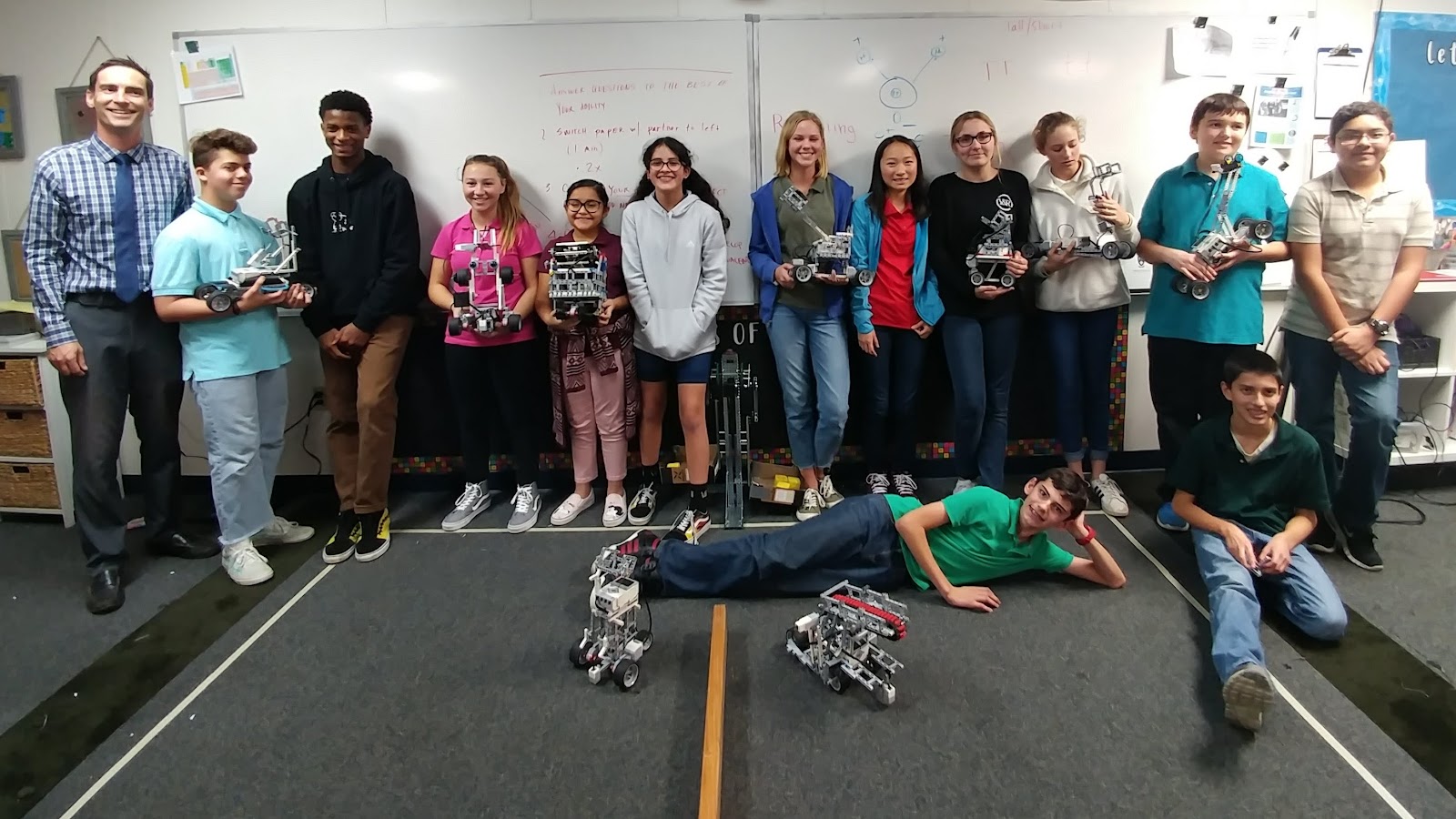
In the event of an emergency, robots may be called upon to enter into areas which have been devastated by natural disaster. The thirteen students from the Foundations of Engineering II class split up into four groups to build such robots, and testing came after eight weeks of work and dedication!

The original CAD model of the obstacle course, constructed
over several weeks by our indefatigable teaching assistants,
seniors Josh and Claire

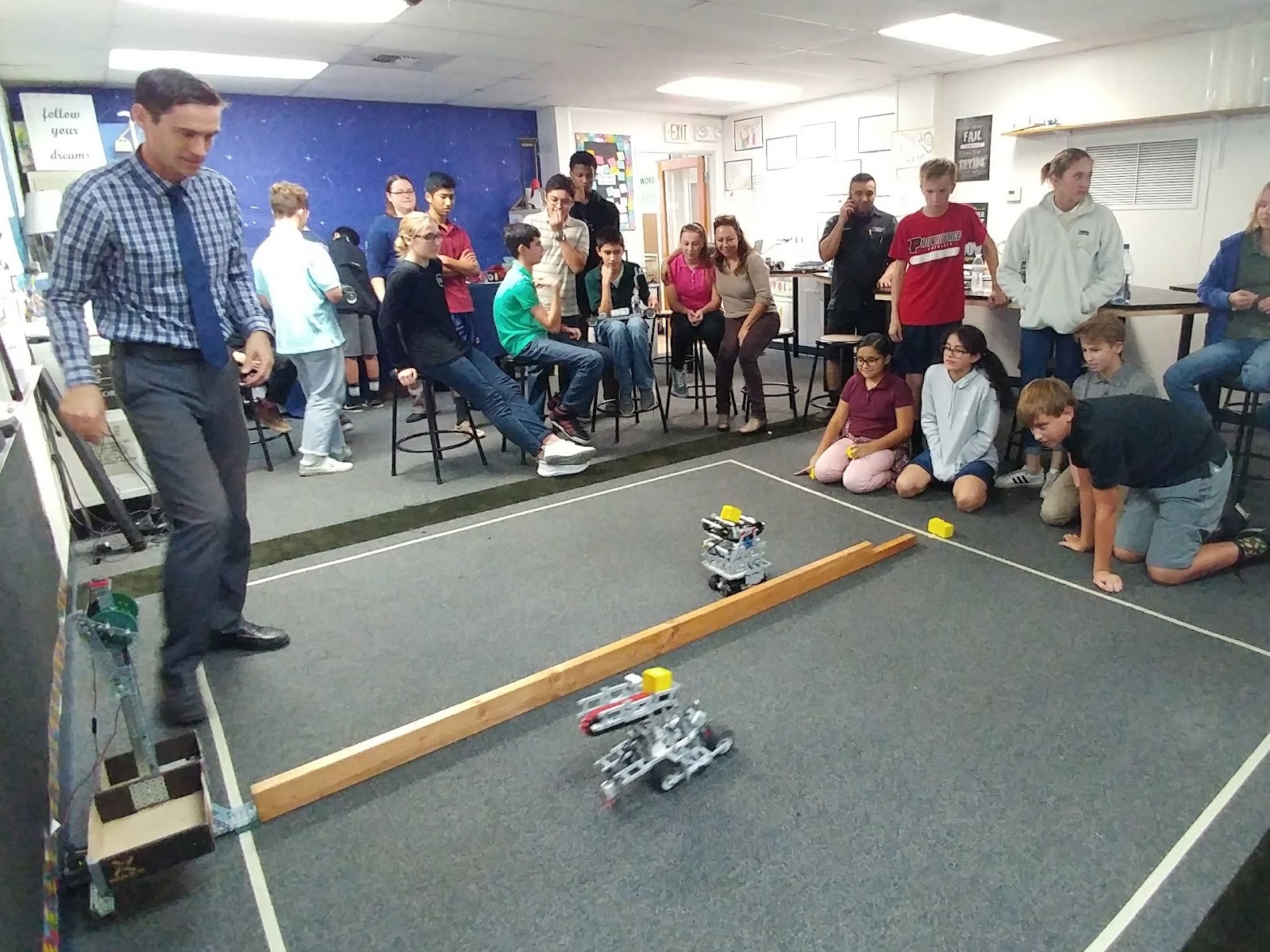
The testing included nine phases (any of which could be skipped) all while carrying a payload. The teams would go through two gates of different sizes, over a gravel pit, up onto platforms of varying heights of 50 and 100 mm, push a block with the mass of one kilogram, go across a chasm, and make their way up a 45° incline. At the end of the run, the robot would be required to drop off the payload. The driver for each team would first do this routine while watching from nearby, and then once again using only a first-person camera view.

Davis gets his team's robot up onto the 50 mm platform with
no worries at all

The first robot to test was the "Trapezoidal Tank”. This robot was built by Nolan, Davis, and Alan. They felt ready for the first trial of the course, but decided to skip the 45° incline. Everything ran smoothly until the payload drop at the very end. They realized something was wrong.

The payload mechanism’s motor came unplugged!

Davis, the driver, thought up an idea. The payload was resting on top of the robot. What if he just flipped the whole robot over? Using the tank’s "tail", he flipped the robot up onto its end and delivered the payload.

Although not able to climb the full 45 degree slope, with a slight
modification the Trapezoidal Tank was make it at 40 degrees

A moment of pure glory! Davis upends the entire robot and performs
the obligatory victory dance!

On the camera-only run, the course was successfully completed again with only one obstacle skipped.

Caleb taking things in his stride, as the long-legged robot effortlessly
clambers over the gravel pit obstacle

Caleb attempts to steer by camera only--
no easy feat! 

Pushing the one-kilogram block away, the package waiting to be
delivered is clearly seen on the right-hand side of the robot

This complex (and squeaky) maneuver involves a series of
high-torque gymnastic activities


Next up was “Daddy Long Legs,” a robot with motorized wheels attached to extended legs. It was built by Caleb, Sydney, and Zach. Caleb, the driver, slowly completed the run, also skipping the very difficult 45° incline. On the camera-only trial, the robot was not able to place the payload in the designated area.

Anaconda brings its bulk to bear on a one-kilogram block of wood

This monster robot leaps 100 mm platforms with
a single bound!


Next was “Anaconda”, built by Sam P., Isaiah, and Pedro. It’s most notable feature? The robot’s tracks could rotate all the way around to point in the opposite direction. Sam P. took the wheel, and on his first run, he only skipped the smaller gate. On the camera-only run, he made it through the same obstacles without any issues.

James steers the Iron Horse through both gates and up onto
the 100 mm platform

Finally, the "Iron Horse” entered. This robot was built by Sam K., James, Joshua, and Kaitlyn. The design was simple yet effective. However, the extra mechanism they had added to their robot at the last minute broke! It was designed to help them get up onto the two platforms. Fortunately, there was enough power available for it to slowly assist with the obstacle it was built for.

Charging over the gravel pit with a huge ground clearance

Shortly after, that extra mechanism fell off and so did the payload. In a lengthy and complicated series of maneuvers, James used the one-kilogram block to push the payload over into the designated area.

End of the road: the Iron Horse capsizes while trying to free its
jammed package (the small yellow catch was supposed to release
and allow the hinged door to fall)

On the camera-only run, the Iron Horse's payload wouldn’t release. James used the gravel pit to try to get the payload to come loose, but the robot flipped over. He attempted to flip the robot back over, but it tipped over on its side instead. This run was incomplete.

The lesson to be learned for these four groups? Each problem can be solved in many different ways, but some are more effective than others. In every problem you encounter, consider those many solutions and then choose the most effective one.

Wednesday, February 21, 2018

In the Steps of Orville and Wilbur

The Advanced Engineering II group has a unique and challenging task in front of them. In fact, it is quite possible that none of the students has ever undertaken something quite like this: a group project that lasts from September to Marchdesigning and building a model glider!

The students have been hard at work learning the fundamentals of aerodynamics, as applied to conventional aircraft. They understand Bernoulli's principle, the momentum shift theory of lift, what induced drag is, and why most modern aircraft have those little turned-up ends on their wings. They know the value of the theoretical lift curve slope, and how much lift an uncambered airfoil produces at a zero angle of attack, and they can check it all in a virtual wind tunnel test! Impressed yet?!

Luke (11th) and Kylie (12th) consult their extensive course notes
as they work on the detailed design spreadsheet

Divided up into four teams, the students have just put the finishing touches on their complex design spreadsheet, which describes in precise detail the various features of the glider they are going to build. Each glider will be thrown from the top of the science lab building onto our field, carrying a single (unboiled!) egg to safety as far downfield as possible. The plane that successfully flies the farthest and lands safely wins!

Tys (12th), Victor (11th), Colby (11th), and Mikaela (12th) happily
nearing the end of their design calculations after several weeks

The students will be using a variety of materials and techniques; we are currently amassing a stockpile of carbon fiber tubes, balsa wood pieces, tissue paper, cellophane, lead weights, aluminum wire, and other bits and pieces. The teams are creating CAD models of their wing cross-sections, intending to 3D print them in the coming weeks. Most of the gliders are about three feet across the wingspan, about two feet long, and weigh a bit more than half a pound. (By the way, all of our work is done in metric units, to be in keeping with international physics standards!)

In order to get a real hands-on feel for the work, the group also took a special visit up to the Santa Ynez Airport, where they were shown a variety of gliders and powered aircraft. This was the perfect chance to connect theory to practice, and it no doubt helped inspire the students as they move into the manufacturing phase.

Josh and Gabe look at the cockpit
of an older glider

Dave and Colby, employees of the airport, graciously showed us around the couple of dozen light aircraft sitting on the runway, answering student questions about wing design, gliding techniques, and the pilot license process.

Megan and Caleb dreaming big as they stand by another one of
the gliders

The students look on as Colby describes the sleek and elegant
Cirrus light aircraft

As more airplanes took off and landed around them, the students got up close views of a shiny Cirrus, many older Cessnas, and an unusual-looking Long-EZ. Colby described to us the great thrill of flying, being in perfect solitude up in the sky; he is working towards his powered pilot license.

Is it a spaceship of some sort? The Long-EZ design is not
recommended for the students to imitate for their glider design

The class's six seniors from left to right: Tys, Mikaela, Caleb, Megan,
Aaron, and Kylie; our guide Colby on the right

With plenty to fill their heads about glide paths, turbulent flow, night navigation, wing construction, parachutes, and fuel pods, the students took one final pose on an aircraft they were allowed to sit in! Thanks very much to Dave and Colby and all of the crew up at Santa Ynezperhaps we'll see you again sometime soon! Airport Day is coming up on Saturday, May 20th, and all are welcome.

Monday, January 22, 2018

MS Engineering: The Final Challenge!

Wow! What an incredible display of robotic strength and fortitude! Mr. Meadth would like to thank all of the eighteen middle school students who worked so hard and waited so long to show their programming prowess. Many thanks also to all of the many parents who came to watch.

Mr. Meadth watches for adherence to the rules of competition
as Kassy and Miranda head off against Tzevon and Mark

Tully and Dennis make the final checks as Audrie and Jeffry
prepare their program

Miranda and Kassy with the biggest, blockiest
bot of them all!

After a gripping round of preliminaries, it was clear that Jon and Ella were not to be beaten, consistently needing only 43 seconds both times to get all three cubes in the goal. Ryan and Gideon zoomed down the line with double wins, as fast as 37 seconds. Kassy and Miranda took it slow and steady, but won both matches with an average of 2:19. A special qualifying round also put Liza and Kaitlyn through with their prize horse, with a record-breaking 18 seconds!


Tully and Dennis proudly showing their machine

Ryan and Gideon were very proud of their
geared-up racer

In the elimination round, Liza and Kaitlyn beat out Jon and Ella with a lightning-fast 21 seconds. The secret? High speed gear ratios, where Jon and Ella stuck to direct drive. And in a stunning upset, Ryan and Gideon lost out--despite their high speed gears--to the perfectly consistent Kassy and Miranda, who beat their previous times by over a minute!

Mark and Tzevon designed a conveyor belt to
get their cubes in the box

Jeffry and Audrie went for the "tall tricycle" design

In an all-girl final round, Liza and Kaitlyn made the first drop. But they fumbled the second, and Kassy and Miranda faithfully dropped theirs in the box to equal the scores. A couple of unforced errors, some bouncing out, and the scores were again tied at two all! In the end, however, nothing could stop the speed and accuracy of Liza and Kaitlyn, who wrapped it all up with an impressive time of 49 seconds! Well done, girls!

For more photos and videos, students can use their Providence Google accounts to check out Miss Hurlbert's online folder, here.

From left to right (rear): Mr. Meadth, Gideon, Jeffry, Audrie,
Kassy, Miranda, Liza, Kaitlyn, Ella, Lily, Paul, Angel
Front: Jon, Evan

Tuesday, June 27, 2017

Providence Engineering Summer Camp: Robot City

What do you get when you put one teacher, three 3D printers, four high school assistants, sixteen kids, three hundred multicolored LEDs, sixteen tiny robots, and 64 square feet of plywood into two rooms for five days?!

Answer: the First Ever Providence Engineering Summer Camp!

Day 1--If You Build It, They Will Come
Pardoning the Field of Dreams misquote, Day 1 was a foray into the world of architecture and design. The upper elementary students broke into four teams, and designed their cityscape. With only a few constraints in place, they freely designed bridges, hotels, apartment complexes, playgrounds, and the mysterious "Geico district." We're still not sure what the market is for robot insurance.

Alena and team search architectural
magazines for inspiration

The first few buildings emerge on Day 1

Sturdy apartment complexes and hotels begin to fill the landscape

Day 2--Light It Up
After a brief lesson in electronics (diodes, conductors and resistors, oh my!), the students set about electrifying their buildings. Silver foil ran this way and that, transporting those much-needed electrons hither and yon. The prize for this day had to go to Tys' group, with their carefully designed master control panel complete with disco dimmers.

Robot City and Britt's Bridge come to life!

One participant's entrepreneurial skills come to light 

Tys overseeing his team's very
formidable end of town

Day 3--Design and Print
Arguably, they should be called 4D printers (since they operate in both space and time), but whichever side you take in this controversy, you have to agree they are a lot of fun. Students learned the fundamentals of computer-aided design (CAD), and then produced their various artifacts: signs, statues, elevators, desks, and... an artifact. The New Matter MOD-t printers ran hot for the remaining days, with many students producing two or more different designs.

An small sample of the dozens of printed designs generated by
the camp participants

Students sit with Alena, eagerly watching their creations emerge
layer by layer

A tiny blue fountain sits proudly on a street corner

Day 4--Rise of the Robots
If all that wasn't enough already, each student was given their own tiny programmable robot. The Ozobot packs a whole lot into one cubic inch, with students writing code for following lines, flashing lights, and dance routines. The robots were programmed in two different ways: with colored racetrack lines, and then alternatively with a block-based in-browser coding language.

These colored trails give the robot a path to follow and instructions
along the way

Lots of practice with the tiny bots

The block-based coding system is a snap!

Many participants created special
mazes and challenges

Day 5--Do Over!
The week finished with a chance to go back to anything and everything! LEGO Mindstorms was used to power an elevator and merry-go-round, more CAD pieces were printed, the Geico district was finally lit up in a convincing fashion, and the robots ran amok. (In the best kind of way!)

The Geico District--now a blazing panoply of light!

Six robots come out for a dance-off!

Jake adds the finishing touches to our
once-humble board--now transformed!
We'll finish with a huge thank you to our marvelous high school assistants, taken from the ranks of our own Engineering Academy; Tys, Jake, Alena, and Samy all did a fantastic job, and we hope they get some good rest this summer.