Showing posts with label construction. Show all posts

Monday, April 5, 2021

Classroom Standing Desk: Delivered!

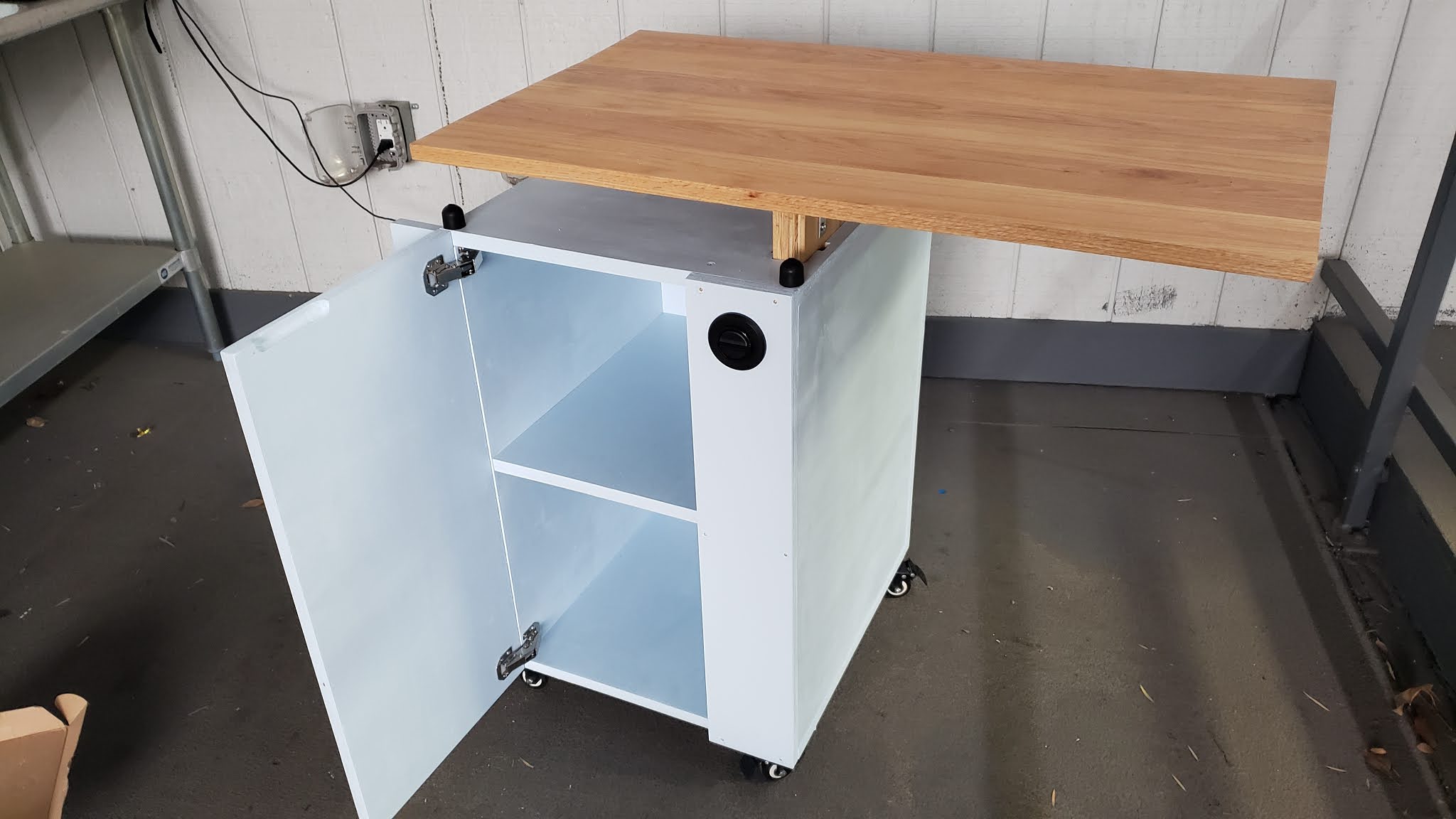
 We've written on this blog about the completion, delivery, and feedback for PathPoint's wheelchair computer desk, but what about the other project intended for Mrs. Jones? We're glad to report that this project has now been constructed, assembled, and painted according to the student plans and delivered to a grateful 4th grade teacher!

Like all of our COVID-friendly projects this year, the design work was done by students: Alan, Davis, Eliana, Isaiah, Kaitlyn, Kassy, Sam, Zach, and Pedro. Their original concepts were submitted as sketches and miniature models back in October 2020.

Alan's early LEGO concept (October 2020)

Mrs. Jones reviewed these concepts and filtered out the ones that were less suitable. The result of this, plus another online design charrette, was a series of simple sketches and a collaborative CAD model in Onshape, which can be accessed here.

The result of a design charrette in December 2020

The final collaborative CAD model emerges

Mr. Meadth acted as fabricator for this project, with Zach in 11th grade contributing a beautiful hand-finished red oak table surface. Angel, while not an actual member of this project, worked after school to attach caster wheels and paint according to Mrs. Jones' requested color scheme.

The linear actuator motor, intended as a replacement for an
armchair recliner and capable of over 150 lb of force

The actuator is sandwiched between
two pieces of plywood

Zach's table surface attached and
actuator extended

In retracted position


From the very beginning, these mechanical furniture designs needed to closely follow the advice given over two thousand years ago by the Roman architect, Vitruvius. Vitruvius was primarily concerned with buildings for home and public use, but his timeless principles seem to fit this project particularly well: firmitas, utilitas, venustas. Translated as "strength, utility, beauty", this triad neatly underscores the challenges and requirements of Mrs. Jones' desk.

Strength: Can a desk be put on wheels and still be stable and secure? How can you design a desk that changes its size and shape without risking damage to users and their property (like a laptop that slips off and smashes!)? When will a cantilever design be so audacious as to become a tipping hazard?

Utility: What features are necessary and useful for any teacher? How to incorporate a maximum amount of storage while allowing room for the electrical mechanism? What are the exact heights that Mrs. Jones requires for her sitting and standing? How much desk space is enough?

Beauty: How do you hide away the necessary mechanical equipment? What should be the focal point of this design to catch the eye? What color and trim will best fit a classroom and suit the client?

Carving out a shallow hole for the wooden handle

The wooden handle structure ready for installation
(note the dowels and holes)

A strap clamp to secure the handle while gluing


Angel attaches the caster wheels

The rubber stoppers are screwed into place after painting

With the door and shelving installed, this is ready for delivery!

In March 2021, after six months of work, it was finally time to deliver the finished product. With the help of Mr. Knoles, the Lower School Principal, Mr. Meadth surprised the entire class one morning with the desk delivery. Mrs. Jones was delighted to receive the desk, and promptly filled it with her hefty teacher editions—which definitely helped as a counterbalance to the cantilever design!

The crew proudly presents their product!

Mr. Meadth surprises Mrs. Jones with the
finished desk!

"So I just press here...?"

Loaded up and ready to go in 4th grade


This project shows us once again that engineers, mathematicians, scientists, and technologists are uniquely poised to love those around them. As we often discuss in the Providence Engineering Academy, it is only those with a particular type of training and set of skills who can turn good intentions into deliverable outcomes. To quote Christian philosopher Etienne Gilson, "piety is no substitute for technique."

Thank you, Mrs. Jones for allowing us to partner with you in such an interesting project this year. It was an admirable test of the students' skills as they sketched concepts, designed CAD models, collaborated interactively, calculated forces and moments, and put saw to wood. Well done to each student who contributed—you are accomplishing great things.


Friday, May 3, 2019

Field Trip to Peabody Stadium

After many months of trying, the Providence Engineering Academy was finally able to secure a field trip to see... well, a field! Peabody Stadium, an integral part of the sporting complex at Santa Barbara High School for almost 100 years, has been greatly in need of renewal for a range of reasons—regular flooding, surface maintenance, seating capability, ADA compliance—and our engineering students were given a sneak peek at the behind-the-scenes process!

Our own neighborhood! Peabody Stadium (old image) to the
upper left, and Providence School to the lower right

A quick walk across Canon Perdido Street brought the group to the construction trailers, where Mat Gradias from Kruger Bensen Ziemer Architects, Inc. met them and introduced them to some members of the construction and design team. Mat has been involved with the Santa Barbara ACE Mentor Program, which several of our students (Eva, Victor, and Seung) have attended for the past two years.

Mat showed the construction plans, and described to the group some of the challenges facing the team, from sourcing grants to managing city wastewater ducts to preserving the "look and feel" of the local neighborhood. The team's original completion date was April 2019, but is now projected for the middle of August.

Josh, Gabe, Victor, Ben, Todd, Colby, Eva, Alena, Claire, and
Madison facing north; behind is the new southern grandstand

There's a lot of mud and dust right now, but over the next few weeks there'll be seeing bright green artificial turf laid out. Regular flooding issues will be a thing of the past, with clever water management systems in the event of severe rainfall. Seating capacity will be greatly improved, and highly directional lighting and sound seeks to minimize light and noise pollution for the surrounding areas. The state-of-the-art track surface will be the only one of its kind for a hundred miles—a type of high-tech material that is known for producing world records.

The Engineering Academy was very grateful to Mat and the other presenters, and they're already excited to see the finished product!

Saturday, December 1, 2018

Tension + Integrity = Tensegrity

The Providence Engineering Academy seeks every year to put skills to use for the benefit of the community. From designing playground equipment to running science lessons, "we have an obligation to turn our skills outward to the world around us; we learn not for our own sakes" (quoted from the Engineering Academy application).

This year, the Advanced Engineering I students took on a challenge from our very own fitness guru, Scott Mitchell. Mr. Mitchell, who teaches middle school P.E. and runs our outdoor education program, is passionate about his craft. He wants students to understand the human body, in terms of both structure and motion. Mr. Mitchell has long used tensegrity structures as an analogy to help students visualize these principles.

What's a tensegrity structure, you ask? While a formal definition is somewhat elusive, you know it when you see it. Popularized by the architect Buckmister Fuller and his student, sculptor Kenneth Snelson, these structures feature "compression members floating in a sea of tension." Still confused?

Here's an animated GIF from Wikipedia's page:


The engineering class began with some small models, using elastic bands for the tension elements and wooden dowels for the compression struts.

Victor with the most simple of all tensegrity structures: three sticks
not touching
Victor and Todd with a six-member icosahedron
Josh finds a new use for the 12-stick version

As simple as these look, they take a great deal of effort to plan and assemble. But this was not the end goal; our class aimed to build a giant version of the icosahedron, with compression members 8 feet long!

Attempt 1:

A lot of knots tied to create 24 rope members. Attached lag bolts to 20 lb beams. Got it together and realized that everything was way too loose. Too much sag. Took it apart.

Alena carefully loops the non-slip knot over the bolt
Ben gets those bolts secured
Inital success and exuberance, but everything is far too loose

Attempt 2:

All rope connections shortened by 5 inches to tighten things up.  Unfortunate result: humanly impossible to pull together. Mr. Mitchell attempted to complete the final connections under great duress. Failure, bent bolts, and an abandoned attempt.


Attempt 3:

Straightened out bolts. Loosened all rope lengths by 2 inches. Realized that we can do this the easy way, working with the structure and not against it. Beams held in different orientation. Pulled it all together, but some bolts bent again. Much tighter, much easier, good result!

Colby and Todd compare the 8-foot version to the 12-inch!

Attempt 4:

Practice makes perfect! Rechecked all ropes, and found a few that were too long. Replaced all bolts with thicker ones twice as strong in bending. Worked in new orientation and got it together in under 10 minutes! (Compare this video to the last.)


Mr. Meadth tests it out before anyone else--in the name of safety,
of course!

Todd climbs inside once everything is approved

Eva's turn!
In case it's not clear from the pictures and videos alone, it has to be emphasized that none of the wooden beams you see are touching each other. Each of them is "floating in a sea of tension", held in place by the 24 ropes. This is despite the fact that the entire structure weighs about 160 lb (73 kg).

Here's another interesting observation: in the interest of safety, we strapped a force gauge to the ropes, and measured 150 lb of tension. (These ropes are rated up to 300 lb, so no problem!) But when Mr. Meadth climbed up on top, weighing about 155 lb himself, the rope tension only increased to 190 lb. How fascinating that 155 lb of live weight does not increase the rope tensions by that amount.

In fact, three people at one time were able to climb up on the structure (totalling more than 300 lb), but the max load reading never exceeded 250 lb, with no evidence of any structural problems.

It's stable, folks! It beautifully and naturally distributes extra load all around to find equilibrium, much like the human body. Even as it moves, it naturally corrects, distorts, and stabilizes. Watch Todd roll a few feet in the following video.


Needless to say, Mr. Mitchell was delighted with the outcome, and brought his middle school P.E. students over to see, touch, and feel its dynamic responses. He taught them that the wooden beams are analagous to our bones, and the tensioned ropes are like our ligaments and tendons and muscles. Inspired by the work of Anatomy Trains, it's easy to see what happens when our bodies are injured or out of alignment.

Great work, students! Keep on dreaming, designing, calculating, and serving others! Please share this article freely with friends and family.

A good day's work!

Wednesday, September 26, 2018

MS Bridges: Welcome to Mr. Eves!

Joining us this year at Providence is the highly qualified Mr. Matt Eves. A long-time friend of Mr. Meadth, Mr. Eves brings his experiences in engineering and business to the AP Calculus AB class with our seniors, and the Intro to Engineering class with the middle schoolers.

Mr. Eves wasted no time in getting down to one of our famous projects: The Bridge! In teams of two, with a list of required constraints, they set about building the longest possible bridge. This is more than just messing around with LEGO; students were demonstrating that they had learned the underlying structural principles of triangular trusses and bending beams.

Josue and Larry measure their jointed creation

Jeffry, one of the able teacher assistants, helps Paul and Ryken

Elizabeth, Carmen, Nate, and Abigail take a moment to smile!

Taylor and Will understood the need for vertical triangles...
is there anything they were still missing?

Tess and Bryce carefully counting the pieces they used

Jonny, another of our teacher assistants, helping Hunter and Reggie

(By the way, if you're wondering about the teacher assistants: Jonny, Jeffry, Emma, and Ruby are all acting in this capacity this semester. Having taken this class once already, they are now bringing their learning to another level by helping the other students. There is no better way to learn than by teaching! They have also been taking time out with Mr. Meadth during class to learn CAD tools, with some of their creations being 3D printed.)

Upon completion, the seven teams laid wooden tracks across their bridges and put them to the test. All teams performed incredibly well, with almost no flexing evident. The following video shows the tests--in each one, what elements of design do you see that are contributing to the bridge's strength?


A great start to the year! Next step: learning about gears and torque. Students will combine these lessons with their knowledge of structural strength to build a special machine... can you guess what it is? All this, so we can learn to build a robot that moves properly and is mechanically strong.

Browse around and check out some of our other recent posts. Feel free to email Mr. Meadth or Mr. Eves for any questions about the Providence engineering programs, and share this post freely with family and friends!

Friday, June 29, 2018

Summer Camp 2018

It was such a roaring success the first time that we just had to do it all over again! The second annual Providence Engineering Summer Camp finished today, and the brightly lit robot city took wings with our special theme: SPACE. We all know it's the final frontier, and our fifteen campers interpreted this idea in a multitude of ways. Alien invasion... meteorite shower... rocket launch... solar system buildings... 3D printed rockets and planets... so much fun!

Todd helps his team with some simple geometric designs

High school engineering students Joshua, Todd, Alena, and Sam led the charge each day teams of devoted campers from Providence and the broader community. We also had a good deal of help from Isabela! These excellent engineers taught the campers how to build electronic circuits, program robots, 3D print fantastic creations, and design out-of-this-world architecture. Illuminated buildings towered high above the cityscape as tiny robots darted to and fro. Electrified copper rails ran this way and that carrying power to critical components, with printed sculptures dotting the landscape.

Success! A single 3 V coin battery powers nine blue LEDs...
or is it only eight?

There was no messing around, either—these elementary students learned their stuff! You can ask them what "LED" stands for, and what a "forever loop" might be used for. They know how to build a working switch out of paper and copper foil, and some of them even used their movie-making skills to record short action videos!

The Robot City landscape continues to become
increasingly illuminated

As the days went by, the creations became increasingly complex. First was the skyscraper that was literally taller than Mr. Meadth. Then came the red/orange/green traffic light by the illuminated airstrip. 3D printed costumes were designed (by the campers, of course) for the tiny Ozobots in the shape of cars, rockets, and trains. And—of course—there was the obligatory fiesta of robot dance parties, all happening in perfect synchronization.

A delightful blue flower stands bold and tall

The end of each day came all too quickly. With lots to take home, we hope these happy campers will continue to code, invent architecture, and design circuits all summer long! Enjoy the rest of the photos, and we hope to have as many of you as possible back next year!

The 3D CAD model (computer aided design), becomes—by magic!—
a brightly lit reality

A tall rocket stands beside a crashed alien spacecraft

Our campers working hard to create all manner of new buildings

The tallest skyscraper in the room, complete with embedded
meteorites and emergency beacons

The Copper Rocket throws an eerie light out onto the empty streets

The giant completed city!


Wednesday, June 13, 2018

MS Final Challenge: Flawless Victory!

A new record was set this semester, with the biggest group ever signing up for Intro to Engineering in Room 202. The eighth cohort to take this class, they were full of excitement as they spent the last four weeks of class designing and building a LEGO robot to respond to Mr Meadth's latest Final Challenge.

In some ways, this was the most difficult challenge yet: the robot would be placed in a square walled ring, collect a colored item, and deposit it outside of the ring. Sound simple? To scoop up a smooth plastic object on a smooth wooden floor and get it over that mere 3.5" of height is far more difficult than it sounds! How does the robot know when it has the item in hand? How can it lift it up? How to release it? Should it be able to steer? How does it know when it hits the wall? Will it behave the same way every time?

The game area: an 8 ft wooden square, with 3.5" high walls; five
items were scattered for collection and removal

Mr Meadth's advice to the students was plain: the robot that won this competition would be fast, simple, and reliable. Fast: this is a race against the clock, with only 30 seconds to beat the other robot in the ring. Simple: every additional moving part is one more thing that can go wrong. Reliable: it must do the same predictable thing time after time.

Left to right: Zach and Sam show their formidable forklift machine

After the last frantic rush of finishing work, eight complex machines lined up to take the floor. Bedecked with an impressive array of forklifts, scoops, and shovels, the robots stared each other down with baleful red eyes (ultrasonic sensors, actually, but the lure of personification is hard to overcome!).

Ruby and Brooklyne's robot finds its way into the corner, missing
the yellow item by a whisker!

After an intense Friday of preliminary rounds, it was clear that one team's robot stood out head and shoulders above the rest; Emma and Donna's machine was indeed fast and reliable. Spearing the item every time, undefeated in every round, they were placed in pole position. Honors also went to Avala and Isabela, who did excellently on the first day.

Left to right: Emma and Donna sit proudly after another
winning round!

Emma and Donna (rear) narrowly beat out Avala and Isabela

Teams were given a chance over the weekend to regroup. Any programming or mechanical fixes could be carried out, in time for the elimination rounds. Several teams took advantage of this, and fine-tuned their bot in the hopes of gaining victory.

Left to right: Masa and Ma.kaha pause for the camera while the
competition rages on behind them!

On the big day, it was made clear once again just how challenging this task was. Several teams did not score even once—it really is that hard! Many teams found their robot just didn't know when to lift the item over the wall. The lesson was hard learned: a robot is utterly deaf, dumb, and blind except for proper sensors and programming.

Left to right: Isaac and Josiah carefully plan their attack vector

After several rounds, Emma and Donna once again distinguished themselves as undefeated at the top of the pack. Avala and Isabela also scored solid victories. Josiah and Isaac also scored a victory, as did Sam and Zach. Caleb and Harry deserve an honorable mention; in the last round they were finally able to remove an item from the field... but it hit the ground a quarter-second later than their opponent!

The semi-final was swift and to the point. Emma and Donna maintained their winning streak by pushing Avala and Isabela out of the competition. Isaac and Josiah beat out Sam and Zach and advanced to the final round.

Would Emma and Donna meet their final match? Sadly for the boys, not this time, and not ever! In an astounding display of consistency, the girls won yet again—with a personal best of 4 seconds—while the boys swung wide and missed the target altogether. Flawless victory!

The final victory! Our photographer Isaiah captures the winning
moment an instant before the item hits the ground.
As always, congratulations to all participants, and to the many parents, staff members, and friends who came out to see the competition across both days. We were thrilled to have you, and we look forward to seeing what the next Final Challenge will be.

From left to right: Caleb, Harry, Zach, Josiah, Zach, Isaac, Brooklyne,
Ruby, Avala, Isabela, Emma, Donna, Cameron, Alan, James, Ma.kaha,
Masa, Isaiah, Sydney, Abby, Mr Meadth