Thursday, February 8, 2018

Educational Design Project


In the Providence Engineering Academy, we emphasize the idea that technology ought never to be an end in itself. Technology for technology's sake rings hollow, and as Christians we ought to see all things as being good and useful for God's kingdom purposes. A very real question for us is this: how can we use engineering, design, and technology to love others? As engineers, are we perhaps able to serve others in ways that others cannot?

In answer to this question, the 9th/10th Grade Foundations of Engineering I class asked for and received requests from our school's own teachers and staff. We asked them what they could use in their classrooms and offices that we could design and then 3D print. In the past, the students have produced models of ziggurats, pyramids, and Solomon's temple. They have made gear ratio demonstrations, ten-sided dice, and computer monitor stands.

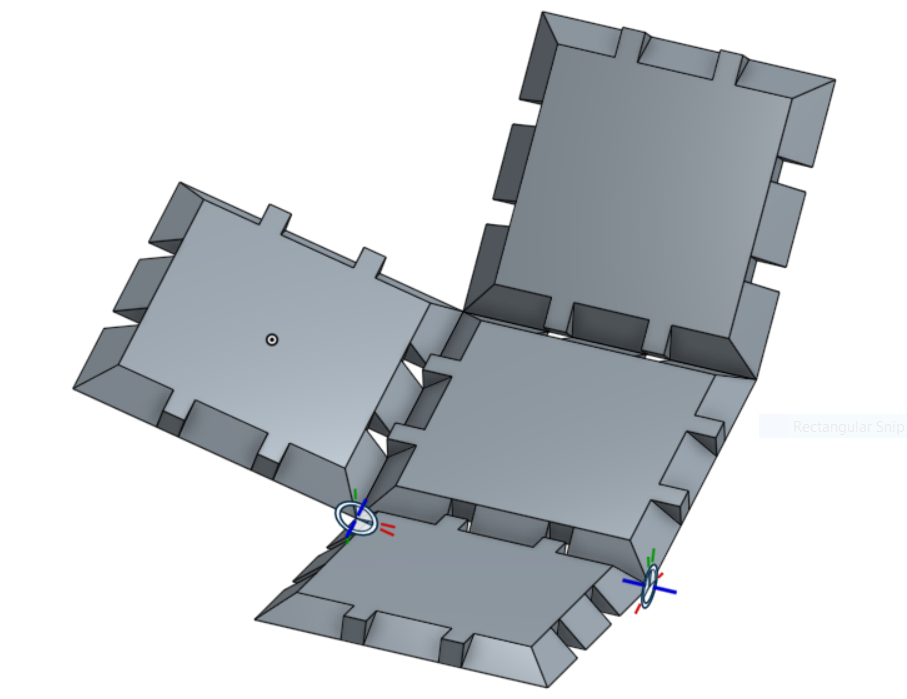
This year, the entries were just as exciting. We start with several geometric demonstrations for Mrs. Smelley, our 7th and 8th Grade mathematics teacher, designed by Ava and Peter. Ava created some simple trapezoid area demonstrations, as well as a cubic volume demonstration. Peter built a folding box that opens up to show how a 2D net is created from a 3D shape. Mrs. Smelley was delighted, telling the students "you have really supplied the tools for our class."

Mrs. Smelley gratefully receives the cubic volume project from Ava 

Peter's folding box design: click here to view the online version

Next up was Sam, with his large model of a cell for Mr. Alker's middle school biology class. Sam created each piece as separate, so students can pull it apart, and really "feel" what they have seen in the textbook.

Sam looks on as Mr. Alker identifies the various bits and pieces

Todd produced a somewhat unique request: an anti-theft device! Mr. Hurt finds that his classroom calculators tend to go "missing", and so he is embarking on a social experiment. Will fastening a distinctive 3D printed science-themed design to the back of them change the outcome? Only time will tell. At the very least we appreciate this practical use of the scientific method.

Todd's design features a striking gold-on-black circuit board pattern

Next in line is Caleb, who designed something along more structural lines: a replacement door handle for a cabinet in our science and engineering lab. This project was a good lesson in meeting external constraints; it had to be strong enough, match up with the existing screw holes, and allow for screws to actually take hold of it. Caleb also added some extra pizzazz.

The new door handle, with Providence logo, in place and ready to go!

Madison designed some calendar labels for Mrs. Penton, enabling her to easily highlight different events as the year rolls by. The labels are removable and have pre-printed words on them for common activities and events.

Mrs. Penton shows off her new designs!

Ben also went the structural route by creating some shelving brackets for Mr. Meadth. Why go store-bought when you can have custom-made? Mr. Meadth greatly appreciated Ben's creativity, as he created dozens of "bubbles" and carefully placed holes to match up with the existing bolt locations.

Ben's brackets support a display shelf for the Calculus class

Pedro helped complete a design that was begun last year by 11th and 12th Graders. The idea was to build a column compression demonstration, showing how compressed columns form a variety of buckling modes, depending on end fixity conditions. Pedro adroitly designed a sliding attachment, which keeps the end of the column from rotating while allowing one-dimensional translation. This will see use next year in classes!

The column testing device is finally
complete, thanks to Pedro

Alena chose to work on the Engineering Academy keychains for next year. We have a tradition of producing simple keychains for everyone in both classes, and Alena is working on something that echoes next year's themes of robotics and structural engineering.

A miniature wrench, courtesy of Alena

And finally, Josh designed a caddy for Ms. Svoboda in middle school. Ms. Svoboda teaches between different classrooms, and this caddy allows her to quickly bring some essential items for her afternoon class. In this case, Josh worked to supplement an existing file holder with customized attachments. Ms. Svoboda was delighted with the results!

Have caddy, will travel!

As a final word, Mr. Meadth and Claire (our 11th Grade T.A.) also worked to produce some pieces for the Providence Preschool. Our new director, Cheri Diaz, wanted some "natural" items, so we printed a starfish, a seashell, a honeycomb, and some ice cubes (all but the ice cubes were found online on Thingiverse). We hope the children enjoy playing with them!


Monday, January 22, 2018

MS Engineering: The Final Challenge!

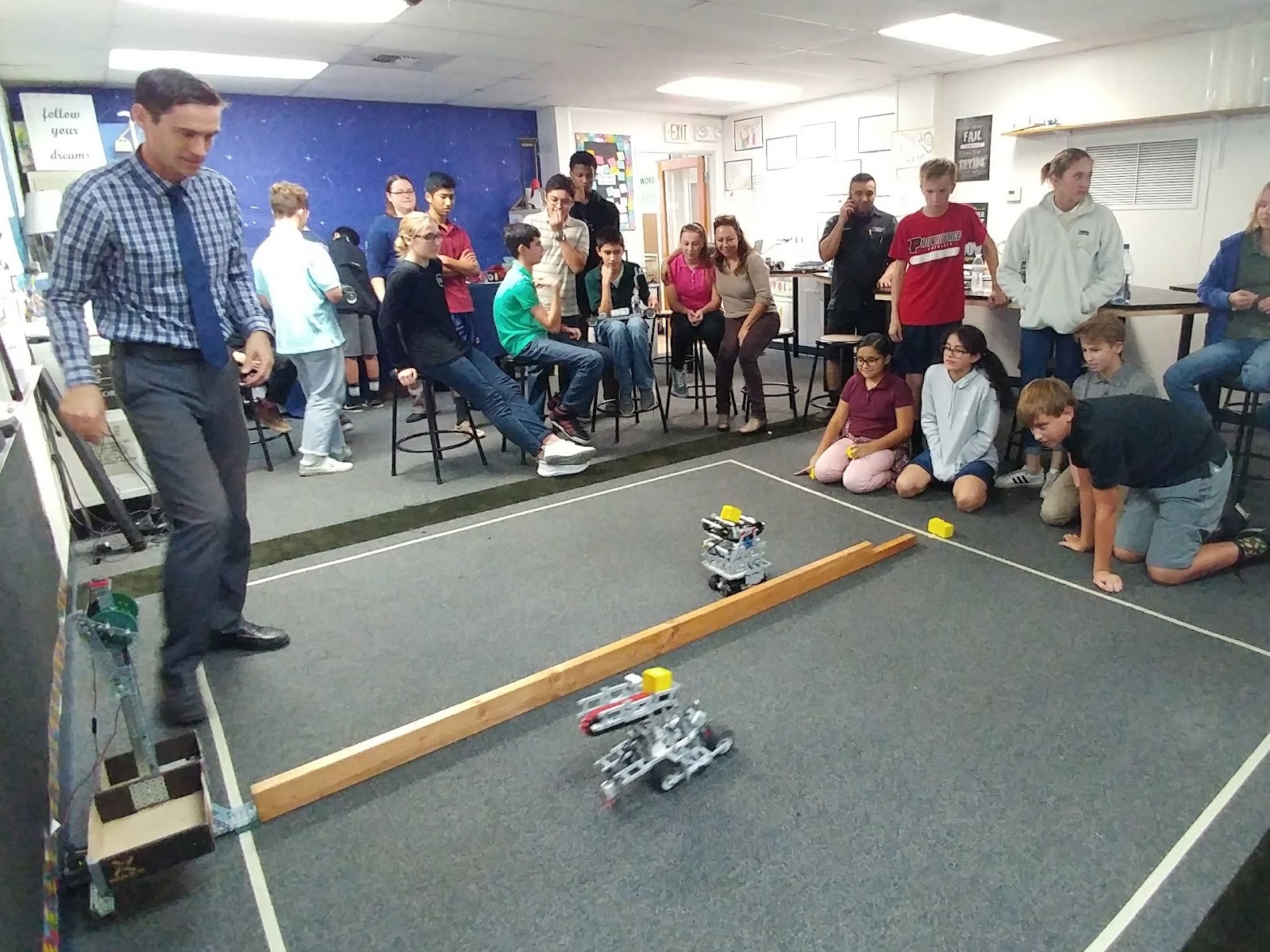
Wow! What an incredible display of robotic strength and fortitude! Mr. Meadth would like to thank all of the eighteen middle school students who worked so hard and waited so long to show their programming prowess. Many thanks also to all of the many parents who came to watch.

Mr. Meadth watches for adherence to the rules of competition
as Kassy and Miranda head off against Tzevon and Mark

Tully and Dennis make the final checks as Audrie and Jeffry
prepare their program

Miranda and Kassy with the biggest, blockiest
bot of them all!

After a gripping round of preliminaries, it was clear that Jon and Ella were not to be beaten, consistently needing only 43 seconds both times to get all three cubes in the goal. Ryan and Gideon zoomed down the line with double wins, as fast as 37 seconds. Kassy and Miranda took it slow and steady, but won both matches with an average of 2:19. A special qualifying round also put Liza and Kaitlyn through with their prize horse, with a record-breaking 18 seconds!


Tully and Dennis proudly showing their machine

Ryan and Gideon were very proud of their
geared-up racer

In the elimination round, Liza and Kaitlyn beat out Jon and Ella with a lightning-fast 21 seconds. The secret? High speed gear ratios, where Jon and Ella stuck to direct drive. And in a stunning upset, Ryan and Gideon lost out--despite their high speed gears--to the perfectly consistent Kassy and Miranda, who beat their previous times by over a minute!

Mark and Tzevon designed a conveyor belt to
get their cubes in the box

Jeffry and Audrie went for the "tall tricycle" design

In an all-girl final round, Liza and Kaitlyn made the first drop. But they fumbled the second, and Kassy and Miranda faithfully dropped theirs in the box to equal the scores. A couple of unforced errors, some bouncing out, and the scores were again tied at two all! In the end, however, nothing could stop the speed and accuracy of Liza and Kaitlyn, who wrapped it all up with an impressive time of 49 seconds! Well done, girls!

For more photos and videos, students can use their Providence Google accounts to check out Miss Hurlbert's online folder, here.

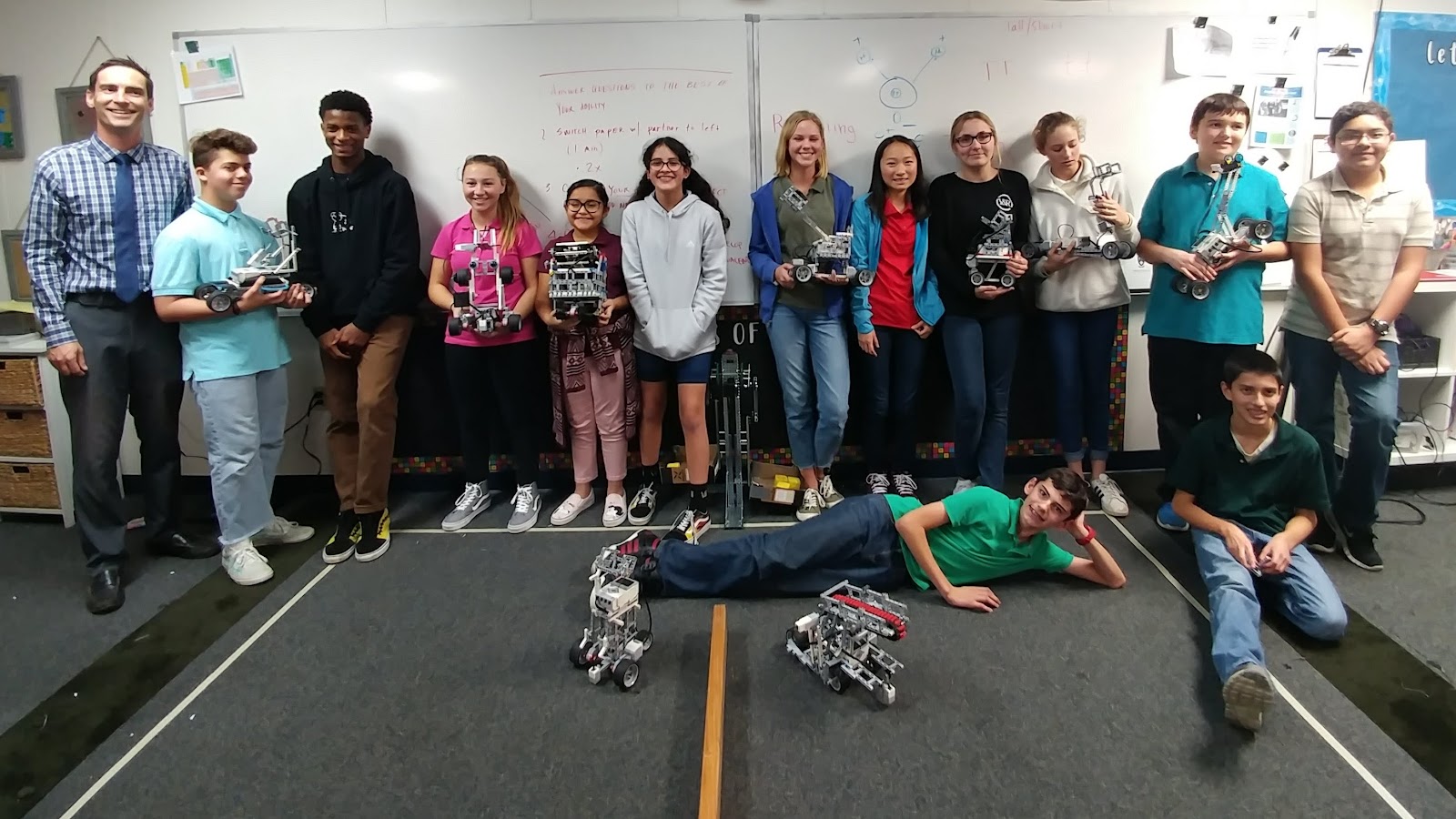
From left to right (rear): Mr. Meadth, Gideon, Jeffry, Audrie,
Kassy, Miranda, Liza, Kaitlyn, Ella, Lily, Paul, Angel
Front: Jon, Evan

Monday, November 27, 2017

MS Engineering: A Photo Update

The MS Engineering students just finished their penultimate project: to build a "stock" model according to instructions, and then to program it themselves to get it to work. This is a warm-up to their final project, which sees them build and program their very own robot in The Final Challenge without any instructions or other assistance.

Enjoy the photos, and feel free to browse our other articles, most of which are focused on the high school Academy. Send your comments and questions to us at rmeadth@providencesb.org.

Ryan and Mark show off their Znap, which moves around in
random directions, snapping at anything that comes too close;
apologies for poor photography!

Gideon and Kaitlyn built a challenging Elephant, which walks
and picks up items with its articulated trunk--very impressive! 

Dennis and Tully also put together a Znap, and learned a lot
about the importance of distinguishing between sensor and
motor ports!

Kassy and Liza (absent) also built an Elephant, which had an
impressively choreographed trunk routine complete with sound
effects; we also wanted to see if it could tip over one of the
puppies 

Evan and Angel built the only Robot Arm H25; it is something
similar to a factory assembly robot, picking up and releasing
objects within its reach

Jonny and Ella put together the only Stair Climber, which was
able to successfully climb the pile of books pictured 

A (mostly) successful earlier test run of the Stair Climber

Tzevon and Paul with their own Elephant and its unique slow-
motion dance routine

Audrie and Miranda consider their robot Puppy--almost as
troublesome as the real thing! 

Jeffry and Lily describing some of the challenges of just getting
their Puppy to stand and sit--who knew it would be so much work?!


Tuesday, November 21, 2017

Guest Article: STEM Without H

(The following is a student piece written by 9th Grader Joshua Frankenfield, in response to two days of discussion concerning the nature of technology, devices, and their positive and negative effects on all of us.  All students were asked to write their thoughts in the style of a blog article, and Joshua's was selected to be published on this site.  Enjoy, leave your encouraging comments, and be grateful for our deeply thoughtful students!)


STEM Without H

STEM is an acronym that many schools have begun to use to describe their academic program. STEM stands for Science, Technology, Engineering, and Mathematics. However, if these are the main four focuses in today’s education, there is a cause for concern. As a student myself, I would recommend adding in an H for humanities, because I believe that we’d be able to learn skills that may benefit us more later in life.

The main problem is that schools today are overly interested in teaching people how to use technology. Don’t get me wrong—technology can be useful in many ways—but there is a difference, according to Andy Crouch, an author and an educator, between the technology of devices and the technology of tools. The difference that he proposes is that tools make you work and become more skilled while devices do the work for you. If schools mainly teach on how to use devices, then the students would be prone to relying too heavily on devices in a manner where they end up not being able to grow in their skill sets. Schools that put an emphasis on devices aren’t putting as many challenges on the students. The students will end up using those devices to make those things easier when, in reality, we grow our heart, soul, mind, and strength if we challenge ourselves. Focusing on devices will diminish how well students are able to handle their own difficulties, whether it be academic, athletic, or social. Focusing on technology has another problem: to what ends will learning STEM go? STEM may eventually be focused on to the point where humanities is severely diminished.

Humanities has two parts to it: literature and history. Literature is important is because it has been a part of culture since the Epic of Gilgamesh. If we let literature slide into an area where it isn’t as important as it was before, then our culture won’t be as complete. This is shown in the novel Fahrenheit 451 by Ray Bradbury, where a world like this is described, and in it, people have esteemed literature as unimportant. The literature was being burned, and people were much less sophisticated because they had no basis of their culture. Plus, destroying literature made only one job (firemen that burned any place books were found), but it lost at least two jobs in the story: the librarian and the novelist. If we neglect literature, then this world would be less creative and less inspiring. Also, literature gives us an idea what the culture values and what concerns them. When we have an idea as to what cultures value, then we are able to connect more readily with other people groups. When connections between cultures occur, trading becomes easier due to less argument.

The other part of humanities is history. History, like literature, is a foundational part of culture. It helps us understand other and ourselves better. According to Providence’s high school Humanities teacher, Mr. Rottman, the reason we need to understand culture is so that we, as Christians, will be able to help people more in their time of need. If we don’t understand their history, then how can we understand the kinds of things the people are going through? We wouldn’t, and technology wouldn’t be able to help them either. Technology on its own is useless because it has no compassion or sympathy. History, therefore, builds up our skill in being able to show empathy for other people.

STEM without H is a horrible idea. I encourage all students and parents everywhere to take a closer look at their school. Does it focus solely on STEM and what it stands for or does it also add in the humanities aspect? If it mainly focuses on STEM, then what can you do to help emphasize the need for humanities? If it adds in the H, then what can you do to keep it that way?

Joshua Frankenfield is a freshman
at Providence, and a proud
member of the Providence
Engineering Academy

Saturday, November 4, 2017

Field Trip: Santa Barbara Forge + Iron

Not far from our Upper Campus is an exciting center of creativity and design. With ties to Westmont College, Providence, and our own Mr Hurt, it's the most natural place in the world to take our engineering students for inspiration...

Santa Barbara Forge + Iron!

Led by Dan and Andy Patterson, the people at Forge + Iron design, hammer, cut, and sculpt all manner of metal creations. You can see their work around town, most recently in the lighting fixtures at MOXI on Lower State Street.

Dan shows the ten students a piece of heavy machinery, designed
to cut through the thickest pieces of steel without blinking--no
touching allowed!

Over the din of hammers and ventilation fans, the students saw some fascinating works in progress. We found a good case study, too, where Dan had begun his designs in the CAD program SketchUp. While the students so far this year have been using a solid-based cloud CAD program called Onshape, they will be switching to SketchUp for the second semester. Creating the three-dimensional model up front allowed Dan to visualize the product, express his ideas to others, and spot potential challenges. Moreover, he was able to export particular decorative geometry from the design, and upload it to their plasma cutter to get just the right shape from the beginning.

The students look on as Dan moves the plasma cutter through its
three degrees of freedom

Computer models and computer-controlled cutting are then combined with the artistry and experience of the master; the team hammers and weathers the precision-cut piece to give it more character.

Students pass by as Andy gives attention to an iron archway,
destined for an existing window frame in Santa Barbara

The brothers' passion for excellence in creativity came through loud and clear. Since our own students are wrapping up their Educational Design Project, where they meet with a client and work with them to develop a satisfactory 3D-printed product, the example of what this looks like in the professional world was well timed.

May we ever be inspired! Thanks to the brothers Patterson for their warm welcome, and to Mr. Rockney for coming along as an extra chaperone.

Thursday, October 19, 2017

EnergyPartners Fund Grant Awarded

Over the past few years, our Engineering Academy has maintained a good relationship with the EnergyPartners Fund, a local nonprofit organization aimed at boosting STEM education in the Central Coast area. Several local energy companies pool their resources to provide much-needed help to schools and clubs and individuals.

Mr. Meadth, Megan, Tys, and Kylie proudly pose

Once again this year, our very own Academy students put their heads together to write a grant proposal for one of our upcoming projects. The request was for a set of quadcopter drone kits, which our students will purchase and build and modify later in this year, as part of their studies in aerodynamics and flight. One of the energy companies in particular, E & B Resources, picked up our project with interest, as they would like to use drones in the future to monitor their pipelines and properties. This is a growing trend in oil and gas industries, as companies strive to use technology to become more efficient.

Mr. Meadth, Kylie, Megan, and Tys listen to Amy Roth read out
their project description
 
Kylie, Megan, and Tys went along with Mr. and Mrs. Meadth to the Santa Barbara Maritime Museum, where Amy Roth from E & B awarded the students with the requested funds. She also extended an invitation to the students to bring their drones, when completed, up to the company operations in Cuyama to put them through some in-field operations!

The gang poses in front of an antique diving suit

Thank you to all students who helped write this grant, and to the three who were able to attend. The Providence Engineering Academy is very grateful to the EnergyPartners Fund, and specifically to E & B Resources. And you can be sure that we'll publish more about the drone project in second semester, so stay tuned!

Extracurricular research at the Maritime Museum

Monday, October 2, 2017

MS Engineering: The First Month

The popularity of the middle school engineering program at Providence has really taken off this year; for the first time, we will be admitting eighteen students in both first and second semester! It's our largest class size yet for this program, which is exciting. But what exactly, I hear you ask, are students doing in that class?

We kicked off the year with some pretty standard stuff. Newton's Laws kept us busy for a little while, talking about how objects in this universe move and interact. The highlight of this unit would have to be the inertia demonstration. Remove one tablecloth very quickly from underneath a dinner set, and hope that inertia does its job! Ryan was a very cooperative test subject.


The students also started the year with some simple challenges, focusing on teamwork, speed, and intuitive design. How many textbooks can you hold up, at least five inches off the table, using only two sheets of paper and a yard of tape? By the way, you only have two minutes to plan and three minutes to build! The class record is 26, held by Josh and Pedro a couple of years ago, but hats off this year to Audrie and Kassy, holding 12 books six inches high. At 3.6 pounds per textbook, that's 43 pounds!

Paul and Lily look on as Ella places her third book; unfortunately,
it was the straw that broke the camel's back

The most recent challenge was to build a bridge between two desks. After learning some basic principles of structural mechanics (triangle rigidity and maximizing the second moment of area of the cross-section), the students set about the task. We always talk in terms of constraints in this class, and the various constraints were as follows:

Materials:
Only allowed to use LEGO beams from a provided parts list

Time:
Three days of class

Personnel:
Teams of two

Length:
As long as possible (maximize)

Load:
Must support wooden train tracks (static load) and a motorized train running across it (dynamic load)

Other:
Must demonstrate the principles of good bending structures that we talked about

After breaking into teams, the students quickly set about collecting their pieces, and sketching their designs. Our enthusiastic students snapped together beams and frames, doing their best to imitate the rigid triangular structures they had been shown.

Gideon, Liza, and Kaitlyn working hard!

Tensions ran high (no pun intended) as the heavy little locomotive crawled across the tracks. The length of the bridges varied widely, from the shortest at 30 cm (1 ft) to the longest at 99 cm (over 3 ft). But most importantly: would the helpless engine tumble into the chasm?

The little engine thought it could, and so did Dennis and Jeffry,
with their sharply defined triangles clearly showing

Audrey and Kassy almost lost their load, but everything held
together in the end!

Miranda and Evan held their breath as the locomotive crawled
across their creation


In fact, although we desperately wanted to see some disaster, not a single one of the bridges failed! This is a new record in the engineering elective, and perhaps a tribute to their collective wisdom and skill (or maybe to their teacher?).

The next challenge? Use their knowledge of torque and rotation to build a crane that can lift as much load as possible.

Kassy and Evan carefully plan their motorized crane

Ella applies the power of a protractor

Dennis and Paul take a break from the drawing board to pose
for the camera

Tully and Liza consider Mr. Meadth's past designs

Stay tuned, and don't forget to ask your students how the work is coming!