Saturday, May 5, 2018

Gliders Launched!

There was a mixture of feelings in the Advanced Engineering II class last week, as they put the finishing touches on their gliders. These thirteen students had conceived, planned, and brought forth finely-tuned creations over the past nine months. The thought of now—literally—throwing them to the wind was somewhat concerning, to say the least.

Aaron throws his team's glider from the roof to the field

Aaron, Caleb, and Megan had worked on a design with the shortest length from nose to tail, which resulted in the lowest weight of all four teams: 281 grams (a bit more than half a pound). They pulled cellophane over 3D printed ribs to create an aerodynamic lifting wing, and they opted for a balsa tail and body, connected by two carbon-fiber rods. Their team was also the only one to decide against undercarriage, relying instead on the rounded fuselage itself to land safely on the grassy field.


In total, this smooth sailplane made about four throws, with some repairs along the way! Sporting flashy silver and gold control surfaces, they reached a maximum distance of 68 ft. It also bears mentioning that the cumulative report with the conceptual and detailed design, plus appendices, came out to a whopping 23 pages. Well done!

Megan, Aaron, and Caleb standing proudly

Kylie, Luke, and Josh had the great honor of building the largest plane, dubbed by some The Spruce Goose. Click here for some serious aviation history behind that name! With a wingspan of 100 cm, a chord length of 22 cm, and a total nose to tail length of over 80 cm, it took to the air for an historic maiden voyage, with Luke at the helm.

Unfortunately, things did not fare so well for this 502 gram glider (a little more than 1 lb), which only made it 17 ft out into the field. Mr Meadth also tried his hand at throwing this one, but this was hampered by some sticky undercarriage. The good news is that the egg onboard was well protected!

Kylie proudly holds the Goose aloft

Luke, showing some signs of stress before the big throw

Left to right: Colby, Mikaela, Tys, Victor, Luke, Kylie, and Josh

Next in line was the Banana Grinder, so named in honor of some typographical errors early on in the design process. Tys, Mikaela, Victor, and Colby also chose to pull cellophane over printed ribs, but decided to rely heavily on the CAD skills of Tys and Colby to construct many other components of the aircraft, resulting in a high construction precision.

Colby and Tys did great work on matching the CAD model
to the real thing

The team worked powerfully together to build a sleek-looking machine. Others commented on the slender, low profile, the extensive use of carbon-fiber rods in wings, tail, and body, and Mikaela's cover page artwork! The Grinder's best launch took it an impressive 60 feet.

Colby waits for the wind to pass before making the throw

Our final team boasted several different features not seen on any other glider. Blue Wonder was the only glider to have a dihedral angle (where the wings slope upwards), it was the only one with a T-tail instead of conventional, and it had the longest wingspan of 120 cm, resulting in the highest aspect ratio. Aspect ratio is a comparison of the wingspan to the wing chord. The students had been taught in class that a high aspect ratio would lower the induced drag. Other teams had aspect ratios around the 4 to 8 mark; Blue Wonder was 12.6.

Eva, Gabe, and Claire also made extensive use of 3D printing and carbon fiber, much like Banana Grinder. Finally, they chose to skin the wing with tissue paper soaked in dope (a kind of glue that dries hard and pulls the paper tight). This resulted in a smoother, tougher lifting surface compared to the cellophane. Click here for the CAD model of their components.

The completed 120 cm wing and T-tail (not yet skinned), connected
by a carbon-fiber rod

It is an unfortunate fact of history that the maiden voyage of this aerial acrobat was a complete disaster. After several successful short-range tests, Gabe hurled the machine into the air... only to have it bank around to port and crash violently into a row of bleachers! With a total distance of only 4 ft and a broken tail, Claire brought out the masking tape to get it ready for another flight.

Gabe hefting the Blue Wonder down on the ground

A second throw left the crowd speechless, as the Wonder curved gracefully into the breeze. After gaining a dozen feet of altitude, it swooped down across the field, showing none of its port-side tendencies, and landed smoothly at 97 ft! Gabe and Mr. Meadth were both able to make a few more flights just as successfully before a few rough landings left it crippled and grounded like the others.


At the close of the experiments, Victor commented that he would never look at an aircraft the same way again; he now sees the c.g. and the balance and all of the work that went into it. And needless to say, Eva and Gabe and Claire were glowing with pride.

So—what was learned?

  1. It is better to have high accuracy construction, which 3D printing perfectly lends itself to.
  2. A dihedral wing angle really does promote roll stability.
  3. The planes' distances were directly linked to their wing aspect ratios (how slender they were).
  4.  Lighter planes flew further and better.
  5. The doped tissue paper seemed to lower the drag compared to the cellophane.
  6. Carbon fiber really is as awesome as it sounds.
With only a few weeks of school left, the students are now turning their attention to a special project, funded by a grant awarded by the EnergyPartners Fund. Broken out into five new teams, they are assembling electronic components for a quadcopter drone. They will design and 3D print the body of the drone, holding all the pieces together. More to come!

Thursday, April 26, 2018

MS Science & Engineering Expo 2018

The annual Middle School Science & Engineering Expo was a huge success once again, thanks to the hard work and positive attitudes of so many students, parents, teachers, and staff. This year's theme of The Human Machine inspired a range of hands-on explorations, from Masa and Cameron's tennis and baseball clinic, to Heidi and Ella's eye dissection, to robotic prosthetic hands built by the Intro to Engineering class.

Harry, Ruby, Isabela, and James show off their robotic hands

Elementary students get in on the action!

Masa shows Mr. Sunukjian how it's done!

Mr. Alker worked hard with every 8th Grade student over a period of several weeks to hone their demonstrations to perfection. With such a rich inspiration as the human body itself, students were well able to explore athletics, biology, physics, and engineering.

Never too young to begin!  Providence class of  2033?

Mr. Alker explains the human lung to a captive audience

Maya walks her family through the inner workings of
the human digestive system

Zach, Isaiah, and Sam with their lung test apparatus

Mr. Meadth also brought some high school engineering students to show off their recently completed gliders. High school 3D printers were running hot all the while, courtesy of Todd and Alena, producing Providence keychains for our guests.

Mr. Hurt, high school science teacher, measures his heart rate
alongside Ava

Heidi and Ella showing the inner workings of a cow's eyeball,
much to the delight of visiting parents

Todd and Alena busily keeping those
printers running on behalf of the high
school Engineering Academy

With sweet treats provided by parent volunteers (thank you!) and Mrs. Luy welcoming guests at the gate, there were plenty of smiles all around. Good things are happening at Providence! For more information about middle school science, please contact Mr. Alker. For more information on our engineering programs, please contact Mr. Meadth. Don't forget to check out the other articles on this blog, and subscribe for automatic updates.

Ella helps two elementary students fill out their scavenger hunt

Abby and Liza calculated the energy delivered in tasty snacks

Lily taught how music affects heart rate

Tuesday, March 27, 2018

Architectural Competition in Santa Ynez

If you had been lurking around the Upper Campus at 6:55 am on Tuesday the 13th of March, braving the rain and stumbling about in the dark, you might just have caught sight of a strange and unusual thing: eight high school students and one teacher loading up into a white van. Wielding scale rulers, plastic triangles, and mechanical pencils, these intrepid adventurers had only two things in mind—the Santa Barbara High School Architectural Competition, and a desire for strong coffee.

Victor, Gabe, and Trevor: together in life, together in architecture!

All grades were represented in the group: Tys (our sole senior); Eva, Gabe, Josh, Trevor, and Victor (juniors); Peter (sophomore); Josh (freshman). They arrived at Santa Ynez Valley Union High School, and quickly found their way to the gymnasium. Along with about 50 other high school students from Dos Pueblos, San Marcos, Santa Ynez, Dunn, St. Joseph's, Santa Maria, and more, they listened attentively as the design challenge was described.

Josh and Peter read the design brief carefully as the
competition begins

The challenge: to design a new fire station that would be both functional and attractive, having a natural "park-like" feel. Constraints were given as to fire truck bay dimensions, equipment lockers, living quarters requirements. Particular difficulty lay in the small size of the property described. Not to be fazed, the students launched into it with gusto!

This competition has been running annually for the last 27 years, conceived and managed by David Goldstien from the Architectural Foundation of Santa Barbara.  Recent winners have come from Dos Pueblos, Laguna Blanca, St. Joseph's, and Dunn. This is the first year that Providence has entered the competition; David reached out personally to our school this year to make us aware and extend his invitation.

Tys, Eva, and Josh working hard and enjoying the day!

It was a long day of creating professional-style scale drawings (site plan, floor plans, and elevations), but the students all agreed that the seven hours had flown by, and they could have done with just a little more time! Gabe commented that this was the "the best icebreaker you could do to get into the world of architecture." Trevor noted that the whole experience "helped us understand how to spend time wisely."

The entries were judged on the same day by practicing architects, and within 24 hours we received some good news: Josh and Gabe had both placed in the top twelve, and were asked to present their designs to the final panel at the Alisal Guest Ranch!

Gabe describes the nuances of his plans to the judges

Josh prepares for his own spiel

In the end, the competition was won by Vivian from Dunn School in Los Olivos. Vivian has placed amongst the winners in years past, and so was well prepared to take the lead. However, our congratulations go out to all of our eight students, and especially Josh and Gabe, who represented Providence so well in their very first attempt. A supervising teacher from Santa Maria commented on the difference that our students exhibit: her students have commented that they want "the Providence confidence!"

Josh and Gabe proudly stand for a photo at the Alisal

The Providence Engineering Academy teaches many different aspects of design and engineering, in its pursuit to "inspire and equip students to find creative solutions to the world's problems through mathematics, science, and engineering, as imitators of a creative God." Architecture is but one of those many exciting elements, and we congratulate all of our participants for their creativity and hard work. For more information on our engineering programs, contact Rod Meadth or download the application packet from the sidebar of this website.

Wednesday, March 14, 2018

Gliders: In Production!

A quick update on our Advanced Engineering II glider project: the students are currently hard at work translating their theoretical calculations into hand-made reality. The problem is at first daunting; how do you create the various parts of a flying machine, according to a specific design? There are dozens of materials that might be chosen for each component, and the production needs to be accurate enough and cheap enough and quick enough and repeatable enough!

Aaron lines his twenty ribs carefully
in place, ready to glue

All teams have settled on a 3D-printed rib-and-spar design for the wings, although the exact rib profile varies in size and shape. All teams are using carbon fiber square tubes for the spars (the long beams that run through from wing tip to wing tip). Some teams are planning on skinning their wing with cellophane, and others are planning on tissue paper and dope (a kind of glue that tightens and hardens the paper).

Kylie and Josh and Luke are producing
the largest, thickest ribs of all teams
(sounds delicious, in fact)

To see some interactive CAD models that Tys and Mikaela and Colby and Victor are working on, click here.

Other components, such as the undercarriage and fuselage and tail, are being made from 3D-printed parts, balsa sheets, more carbon fiber, and even colorful pipe cleaners.

Victor, Colby, and Mikaela go over the particulars of their CAD
model with Dr. Nathan Gates, retired aerospace engineer

Megan and Caleb receive valuable
advice from our classroom mentor

To help with the design process, we asked retired aerospace engineer Dr. Nathan Gates to visit our classroom. Dr. Gates moved around the different teams to consult with them. Each team explained their design, and received valuable feedback as to their construction plans. Dr. Gates' area of expertise was structural mechanics; he was doubtlessly overqualified for this role!

Proud Providence alumna Willow looks over Gabe's and Eva's
wing design

To further sweeten the deal, we also asked Willow Brown, Providence alumna (2015), to come by on the same day. Willow's sister, Kylie, is on a team with Luke and Josh. Willow is currently studying mechanical engineering at Loyola Marymount University. Did this give Kylie and her team an unfair advantage? Only time will tell.

The maiden voyage is fast approaching, so watch this space. There's more coming up later this year, too—students will design, print, and build quadcopter drones. Stay posted, and thank you to Dr. Gates and Willow!

Wednesday, February 21, 2018

In the Steps of Orville and Wilbur

The Advanced Engineering II group has a unique and challenging task in front of them. In fact, it is quite possible that none of the students has ever undertaken something quite like this: a group project that lasts from September to Marchdesigning and building a model glider!

The students have been hard at work learning the fundamentals of aerodynamics, as applied to conventional aircraft. They understand Bernoulli's principle, the momentum shift theory of lift, what induced drag is, and why most modern aircraft have those little turned-up ends on their wings. They know the value of the theoretical lift curve slope, and how much lift an uncambered airfoil produces at a zero angle of attack, and they can check it all in a virtual wind tunnel test! Impressed yet?!

Luke (11th) and Kylie (12th) consult their extensive course notes
as they work on the detailed design spreadsheet

Divided up into four teams, the students have just put the finishing touches on their complex design spreadsheet, which describes in precise detail the various features of the glider they are going to build. Each glider will be thrown from the top of the science lab building onto our field, carrying a single (unboiled!) egg to safety as far downfield as possible. The plane that successfully flies the farthest and lands safely wins!

Tys (12th), Victor (11th), Colby (11th), and Mikaela (12th) happily
nearing the end of their design calculations after several weeks

The students will be using a variety of materials and techniques; we are currently amassing a stockpile of carbon fiber tubes, balsa wood pieces, tissue paper, cellophane, lead weights, aluminum wire, and other bits and pieces. The teams are creating CAD models of their wing cross-sections, intending to 3D print them in the coming weeks. Most of the gliders are about three feet across the wingspan, about two feet long, and weigh a bit more than half a pound. (By the way, all of our work is done in metric units, to be in keeping with international physics standards!)

In order to get a real hands-on feel for the work, the group also took a special visit up to the Santa Ynez Airport, where they were shown a variety of gliders and powered aircraft. This was the perfect chance to connect theory to practice, and it no doubt helped inspire the students as they move into the manufacturing phase.

Josh and Gabe look at the cockpit
of an older glider

Dave and Colby, employees of the airport, graciously showed us around the couple of dozen light aircraft sitting on the runway, answering student questions about wing design, gliding techniques, and the pilot license process.

Megan and Caleb dreaming big as they stand by another one of
the gliders

The students look on as Colby describes the sleek and elegant
Cirrus light aircraft

As more airplanes took off and landed around them, the students got up close views of a shiny Cirrus, many older Cessnas, and an unusual-looking Long-EZ. Colby described to us the great thrill of flying, being in perfect solitude up in the sky; he is working towards his powered pilot license.

Is it a spaceship of some sort? The Long-EZ design is not
recommended for the students to imitate for their glider design

The class's six seniors from left to right: Tys, Mikaela, Caleb, Megan,
Aaron, and Kylie; our guide Colby on the right

With plenty to fill their heads about glide paths, turbulent flow, night navigation, wing construction, parachutes, and fuel pods, the students took one final pose on an aircraft they were allowed to sit in! Thanks very much to Dave and Colby and all of the crew up at Santa Ynezperhaps we'll see you again sometime soon! Airport Day is coming up on Saturday, May 20th, and all are welcome.

Thursday, February 8, 2018

Educational Design Project


In the Providence Engineering Academy, we emphasize the idea that technology ought never to be an end in itself. Technology for technology's sake rings hollow, and as Christians we ought to see all things as being good and useful for God's kingdom purposes. A very real question for us is this: how can we use engineering, design, and technology to love others? As engineers, are we perhaps able to serve others in ways that others cannot?

In answer to this question, the 9th/10th Grade Foundations of Engineering I class asked for and received requests from our school's own teachers and staff. We asked them what they could use in their classrooms and offices that we could design and then 3D print. In the past, the students have produced models of ziggurats, pyramids, and Solomon's temple. They have made gear ratio demonstrations, ten-sided dice, and computer monitor stands.

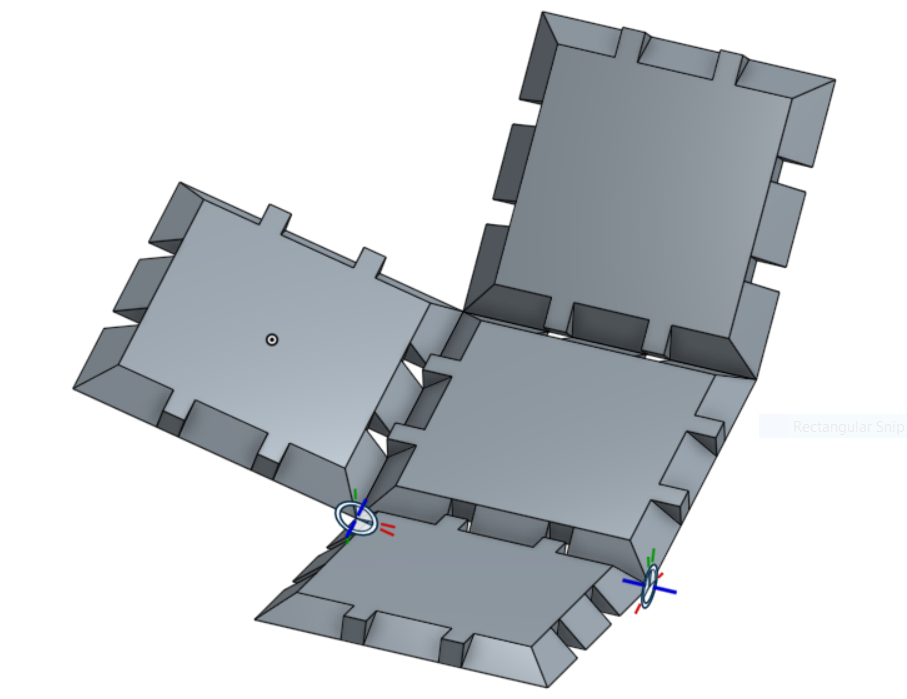
This year, the entries were just as exciting. We start with several geometric demonstrations for Mrs. Smelley, our 7th and 8th Grade mathematics teacher, designed by Ava and Peter. Ava created some simple trapezoid area demonstrations, as well as a cubic volume demonstration. Peter built a folding box that opens up to show how a 2D net is created from a 3D shape. Mrs. Smelley was delighted, telling the students "you have really supplied the tools for our class."

Mrs. Smelley gratefully receives the cubic volume project from Ava 

Peter's folding box design: click here to view the online version

Next up was Sam, with his large model of a cell for Mr. Alker's middle school biology class. Sam created each piece as separate, so students can pull it apart, and really "feel" what they have seen in the textbook.

Sam looks on as Mr. Alker identifies the various bits and pieces

Todd produced a somewhat unique request: an anti-theft device! Mr. Hurt finds that his classroom calculators tend to go "missing", and so he is embarking on a social experiment. Will fastening a distinctive 3D printed science-themed design to the back of them change the outcome? Only time will tell. At the very least we appreciate this practical use of the scientific method.

Todd's design features a striking gold-on-black circuit board pattern

Next in line is Caleb, who designed something along more structural lines: a replacement door handle for a cabinet in our science and engineering lab. This project was a good lesson in meeting external constraints; it had to be strong enough, match up with the existing screw holes, and allow for screws to actually take hold of it. Caleb also added some extra pizzazz.

The new door handle, with Providence logo, in place and ready to go!

Madison designed some calendar labels for Mrs. Penton, enabling her to easily highlight different events as the year rolls by. The labels are removable and have pre-printed words on them for common activities and events.

Mrs. Penton shows off her new designs!

Ben also went the structural route by creating some shelving brackets for Mr. Meadth. Why go store-bought when you can have custom-made? Mr. Meadth greatly appreciated Ben's creativity, as he created dozens of "bubbles" and carefully placed holes to match up with the existing bolt locations.

Ben's brackets support a display shelf for the Calculus class

Pedro helped complete a design that was begun last year by 11th and 12th Graders. The idea was to build a column compression demonstration, showing how compressed columns form a variety of buckling modes, depending on end fixity conditions. Pedro adroitly designed a sliding attachment, which keeps the end of the column from rotating while allowing one-dimensional translation. This will see use next year in classes!

The column testing device is finally
complete, thanks to Pedro

Alena chose to work on the Engineering Academy keychains for next year. We have a tradition of producing simple keychains for everyone in both classes, and Alena is working on something that echoes next year's themes of robotics and structural engineering.

A miniature wrench, courtesy of Alena

And finally, Josh designed a caddy for Ms. Svoboda in middle school. Ms. Svoboda teaches between different classrooms, and this caddy allows her to quickly bring some essential items for her afternoon class. In this case, Josh worked to supplement an existing file holder with customized attachments. Ms. Svoboda was delighted with the results!

Have caddy, will travel!

As a final word, Mr. Meadth and Claire (our 11th Grade T.A.) also worked to produce some pieces for the Providence Preschool. Our new director, Cheri Diaz, wanted some "natural" items, so we printed a starfish, a seashell, a honeycomb, and some ice cubes (all but the ice cubes were found online on Thingiverse). We hope the children enjoy playing with them!